
Much of the focus on activity and health trackers is on wearables. Think Fitbit, Apple Watch, and so forth. However, arguably, this isn’t the best approach for sleep tracking given that such devices need to be plugged in every few days or so and nighttime is the most logical time to do so.
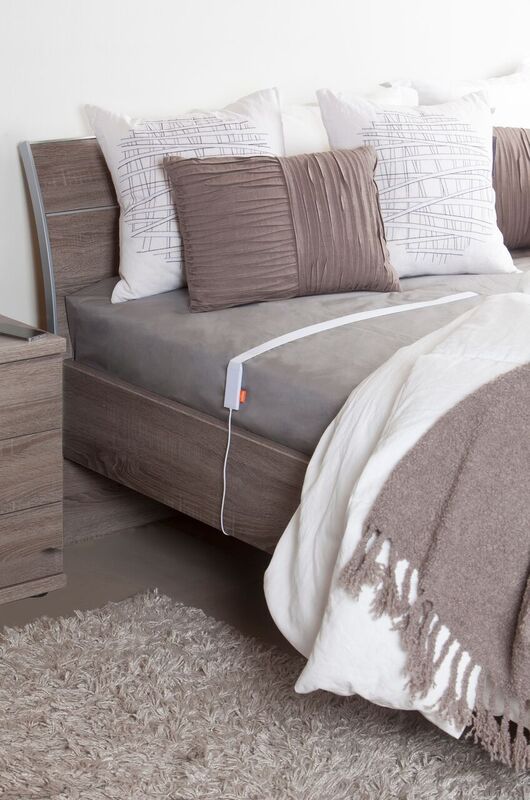
The $150 Beddit Smart offers an alternative. It’s a thin strip that lays across your mattress, plugs into a USB port for power, and interfaces with iOS and Android apps over Bluetooth. In my testing, the strip worked even if it was underneath some amount of padding—a featherbed in my case. (The photo is a bit misleading; normally the sensor would be under at least a sheet.)
The strip is a force sensor which measures mechanical cardiac activity using ballistocardiographs (BCG). According to the company, "Each time the heart beats, the acceleration of blood generates a mechanical impulse that can be measured with a proper force sensor.” By contrast, sleep clinics generally use polysomnography (PSG), which is basically a fancy way of saying that they use a variety of data from different sources to measure things like brain waves and eye movements.
This brochure provides more details about the science behind the device. While I certainly didn’t have the equipment to personally calibrate results against medical equipment, the Beddit’s data appeared to be at least roughly consistent with the readings from my Fitbit Charge HR over the same period. The Beddit, however, provides more detailed tracking of how much you’re moving around. In conjunction with a smartphone, it can also track snoring. (The Fitbit relies on data from its accelerometer which can only measure comparatively gross movements.)
If you really want to geek out, here’s a PhD thesis by Joonas Paalasmaa, the CTO and Chief Scientist of Beddit, from the University of Helsinki about monitoring sleep with force sensor measurement. A force sensor is a thin and flexible force sensing resistor in an electrical circuit. When the force sensor is unloaded, its resistance is very high. When a force is applied to the sensor, this resistance decreases. Various techniques can then be applied to the resistance data to infer heart rate and respiration, which can then be correlated to sleep state.
Part of the motivation behind using the ballistocardiograph approach is that it can be practically implemented in a consumer product, while providing more detailed information than a worn accelerometer can provide. At the same time, as Paalasma’s thesis notes, mainstream sleep monitoring systems require the use of wearable sensors that can degrade the quality of sleep. "The unobtrusive measurement approach is particularly attractive for long-term use at home—even months or years—because the sensors are not expensive and no discomfort is caused to the user."
The sensor is unobtrusive. You do need to be sleeping on it though so if you move around a king-size bed, you’ll lose some results. Over the course of my testing, there were a couple of times during the night without data—presumably because I rolled off the sensor. Other than this reality inherent in a device you’re not wearing, I didn’t find anything about the device that didn’t work as advertised.
So, are you a potential customer for this?
If you have a desire to specifically track sleep, I’m inclined to give this device the nod over a Fitbit Charge HR (which is the wearable I have personal experience with). The fact that you can pretty much plug in the Beddit and forget about it gives it an advantage over a wearable that needs to be taken off and recharged every few days. Furthermore, the sleep data is more detailed in the case of the Beddit and is directly based on academic scientific research. The downside is that fitness bands track more than sleep and also aren’t constrained to being installed on a single bed.

The broader question, and it’s one that I have about many wearables, boils to something like this. OK, now that you’ve had a few days of fun and looked at your graphs, so what? How quantified does your life really need to be?
One answer of course is not very. The Beddit Smart tells me I generally sleep pretty well. But I pretty much knew that. (And my Fitbit tells me that I sometimes sleep poorly when I travel. I knew that too. It also tells me that when I spend all day writing, I don’t walk enough. Sadly, I know that as well.)
On the other hand, I could certainly see someone who doesn’t think they’re sleeping well finding a device like this a relatively inexpensive way to get some data before taking more serious steps to get to the root of the problem. The CDC estimates 50 to 70 million Americans have a sleep or wakefulness disorder.
I guess you could also try to quantify the degree to which a cup of expresso after dinner ruins your sleep although, like fitness tracking generally, I tend to be rather less systematic about such things.
Bottom line: Especially if you don’t already have a fitness band that tracks sleep, the Beddit Smart worked as advertised and is a good choice if you want to quantify your sleep patterns.
Disclaimer: The company provided me with a review unit but the opinions expressed in this review are strictly my honest evaluation of the product.

