Tuesday, March 13, 2018

Podcast: Open source past, present, and future with the Linux Foundation's Jim Zemlin

Zemlin

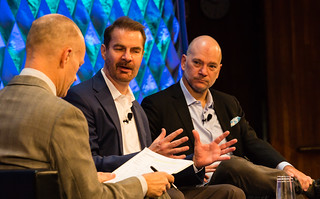
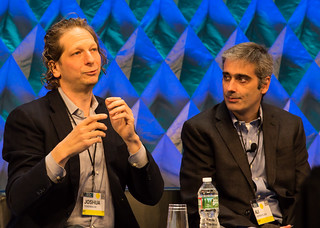
Jim Zemlin carved some time out of his busy schedule to sit down with me at the Open Source Leadership Summit in early March 2018. I’ve known Jim since he took this role when the Linux Foundation was formed by the merger of the Free Standards Group and the Open Source Development Labs in 2000, right around the time that I became an industry analyst. 

In this podcast, Jim reflects back on how Linux and open source have evolved, the lessons he and the Linux Foundation (where he is the executive director) have learned, and why open source has become so pervasive. He talks about “the defeatism of free-riding” and how over time, the recognition that there’s business value in collectively-developed software has become increasingly widespread.

Listen to the podcast MP3 [00:18:10]

Listen to the podcast OGG [00:18:10]

[Transcript]

Gordon Haff:  I'm very pleased to be here at the Open Source Leadership Summit with Jim Zemlin who has taken time out of his very, very, very packed schedule here. He's the Executive Director of the Linux Foundation.

Jim, you headed the Free Standards Group until it merged with the Open Source Development Labs to become the Linux Foundation. That was clearly a very different time for open source, generally, and Linux, in particular. I'm probably showing my age as well that I probably met Jim right when he took this position.

Can you describe your involvement early on, how you thought about open source at the time, and how things have changed since then?

Jim:  I grew up in the computing industry, to some degree. My father was a computer programmer growing up. My grandfather was a programmer, oddly. He was also one of the founders of the company called Cray Research, and that's just been part of my blood.

The funny thing is that this job combines something that's technical with something that was a big influence on my grandmother's side. She was a single mom of my father and my uncle. My uncle, who's mentally disabled, and in 1953 she started the first vocational education nonprofit for adults with developmental disabilities.

When you see someone working at, maybe, a restaurant or somewhere that have these developmental disabilities, my grandmother started this organizational opportunity workshop to help them find opportunities and live their lives in a meaningful way.

It was this combination of two huge influences, the nonprofit work and technology. For me, that's what was the appeal of getting into this. Now having said that, I do recall at the same time meeting my ‑‑ now ‑‑ wife for the first time, and having her ask me what I did for a living and say, "Well, I work at this nonprofit and it's technology. It's all open source. Everyone shares everything." The look of disappointment on her face was just palpable.

Since then, our organization, which I consider this supporting cast in open source and Linux and the projects we work on, has certainly grown. Much more importantly, open source as a way of collectively innovating and creating incredible technology has grown exponentially.

It's now part and parcel to how almost every technology, product, and service is built.

Gordon:  You started out in Linux. Really, what we've seen over the last number of years has been this morphing from everything's about Linux. Of course, there have been other projects, like Apache, and so forth for a long time.

Still, there was this centrality of Linux to everything. It's obviously still very important. You employ Linus, and so forth. The Linux Foundation and the industry more broadly has come to be about so many other forms of open source.

What was the point, as executive director of the Linux Foundation, did you come to realize or to start making a real effort to broaden the Linux Foundation to encompass all these other things?

Jim:  Yeah, it happened. Good timing and luck beats any grand strategy every time. It started when open source as, again, a more mainstream innovation platform, started taking off in the tech sector. I would have organization after organization come to me.

They didn't want to talk about Linux, they wanted to talk about the process about how open source works or what the legal frameworks were. They were no longer wondering whether or not Linux itself, as a technology, was good, or secure, or reliable, or scalable.

They were no longer concerned about whether or not open source was an important thing or of high value as a way to innovate. They wanted the specific playbook. They wanted the detailed instructions on "How do I take code, co‑develop it with, maybe, my competitors or my peers.

"What licenses should I choose? What do those legal licenses mean so that I can share effectively? How do I build an engineering organization that can work both internally and externally to my particular firm? How do I build an open source project with thousands of people? How do I make that scalable?"

They wanted that. Of course, Linux was the quintessential existence proof of good open source projects. Because of that, we started to say, "Hey, if we can take some of the best things around Linux, and the processes, and the methodologies and lend them to other technologies that would of super high value."

To some degree, we got dragged into it. Then over a number of years, we've just been improving how we help grow open source projects, whether it's Kubernetes, or Hyperledger, or Node.js, or others to create massive ecosystems around them.

In retrospect, Linux proves to be one of the more exceptional unique projects [laughs] in terms of how it's organized and how it's run, and so forth. We started, in terms of lending the best practices of Linux, to create these big ecosystems around different technologies.

Different open source projects have proven to be less and less of those practices and more of just borrowing from the great comments of the open source community in terms of how to run these.

Gordon:  What's, maybe, the biggest couple of lessons you think you've learned in the last 10 years or however many years, things that have surprised you, things that you didn't expect, things that caused you to revisit your assumptions?

Jim:  I mean, humility is something that you certainly have to have in this particular role myself. That's the personal lesson that I've learned over 10 years or more than that, I guess, about 15 years now. Is that being in the background leading through influence, being the supporting cast, letting people rise to the greatness that's in them through these great projects, and not taking credit for any that work, showcasing those people, whether it's a developer or an attorney who's moved the needle on convincing their firm to participate in open source in a big meaningful way.

It's the most important part of what I have learned is that at the foundation we have this saying, and it's part of our culture, of being humble, hopeful, and helpful. It's what we need to do. The humility is we're not the rock stars, or the folks who create all the value. It's developers and folks who invest in these communities and create incredible technology products and services from them.

The hopeful part is, I'll tell you, almost every project we start, many people tell me that it will never work and that we're doing everything wrong. [laughs] If you're not optimistic, it certainly can be very, very difficult.

Then the helpful part is just what we do. We're facilitators in bringing together now over a thousand organizations from all over the world and tens of thousands of developers to work on modernizing the world's mobile networks.

Or using open source technology to manage the Walmart's food supply chain, or creating an automotive system for 20 million production vehicles. We're not going to actually do that. Developers and companies, like Toyota, who make automobiles and roll them out by the millions are the ones who are responsible for that.

That lesson of humility, and optimism, and helpfulness is what I think is the most important one for me, at least.

Gordon:  Let's look forward. I've been going to these events for a long time. My impression is that for quite a few of those years you and others in the Linux Foundation almost felt a need to celebrate open source and Linux and send the message that, "Look, this stuff's really important, and these are all these great stats about it."

Your keynote yesterday was interesting because it was like, "We don't need to do that any longer, but we're not perfect. We're not there. We need to keep improving." You talked to the audience about where some of the areas you think open source still has work to do."

Jim:  Again, no one needs to be convinced these days that open source is doing great, although I will say I do like to indulge in talking about how great it is every now and then. It's part of the job.

What I showed yesterday, I mentioned that these are intentionally detailed slides that I'm showing. There's a lot of very detailed methodology behind the interplay of building a community that is a great upstream to a downstream industry that is taking this code and using it.

It doesn't necessarily have to be for‑profit, it can be governments. We saw the National Oceanic Atmospheric Administration, NOAA, today talking about how they're using open source to share big data to help with climate change and help with our oceans.

At the same time, we saw a commercial company Change Healthcare which manages two‑thirds of the medical claims in the United States using open source Hyperledger to make that process work.

We need a detailed way to say, "Upstream to create an ecosystem of knowledgeable developers from many diverse backgrounds solving a meaningful problem, sharing intellectual property, providing some form of consistency and conformance of those projects so that they can be downstream consumed in these wonderful ways. It's something that's detailed.

"We can improve upon in terms of the speed in which those ecosystems can grow. Then the pace at which they can be consumed and reinvested back in."

I was intentionally detailed because we can always get better at, for example, how do we create more secure code in upstream projects? How do we take the responsibility of this code being used in important systems that impact the privacy or the health of millions of individuals? These are always areas that we can improve in.

This event where you have the actual people who make the decisions about what code goes into what particular projects and the community leaders who are maintainers at these huge open source projects to get together and collaborate on how we can improve those things.

Again, whether it's cybersecurity, whether it's new licenses for sharing large data sets, whether it's ways to automate the sharing of AI models that have been trained for various purposes and can be reused effectively across different competitors or peers.

Those are all the things we can improve in. That was the detail that matters. All the rest is typical Zemlin hyperbole about how great open source is. People have seen that movie before.

Gordon:  Open source is interesting today. You have this loose confederation of companies that are working together, contributing to the commons individually, any of these companies could pull back and free ride on what others are doing. Arguably, some do more than they should.

How do you see this going forward? Is this a new type of business relationship, or has it always existed?

Jim:  I'll tell you over 10 years ago, a lot of my personal time, and a lot of time of our organization, was spent convincing organizations of the defeatism of free riding in open source projects.

We had written white papers on why it would be important to open source your device drivers for Linux, and showed the actual business value of having collectively maintained in open drivers as opposed to trying to maintain some random proprietary driver, and so forth.

We would explain the futility of just forking an open source project and not sharing your changes back so much to the degree to which you've defeated the whole purpose in terms of collective value. You're now, basically, supporting your own proprietary fork, whether or not it's open source. It doesn't matter at that point. No one understands it but you.

The epiphany that many companies have had over the last three to four years, in particular, has been, "Wow. If I have processes where I can bring code in, modify it for my purposes, and then, most importantly, share those changes back, those changes will be maintained over time.

"When I build my next project or a product, I should say, that project will be in line with, in a much more effective way, the products that I'm building.

"To get the value, it's not just consumed, it is to share back and that there's not some moral obligation, although I would argue that that's also important. There's an actual incredibly large business benefit to that as well." The industry has gotten that, and that's a big change.

Gordon:  Over a relatively short period of time, I would argue, at least, in the broad landscape this recognition that open source is not this hippy thing, but that it does deliver business value for companies.

Jim:  This morning it was such a fun session where we had Mark Russinovich, the CTO of Microsoft Azure, talking about how important open source is to the AI platforms they're building and how they're using open source to diagnose pneumonia in children.

You heard the least hippy, at least, from my perspective, company in the United States, Home Depot, talking about how important open source is, not just to building their tools to help automate the systems that help run Home Depot. But to hire developers that want to come work at Home Depot, if they're seen as an open source company.

NOAA, the National Oceanic Atmospheric Administration is just a very old and non‑hippy, very conservative organization. You hear them talking about how important open source is for them and how important it is for allowing them to share the petabytes of data that they have with the world.

We've thoroughly crossed over into the non‑hippy part, although I will say there is a special place in my heart that will live forever for the antiestablishment sensibility that is represented in the open source movement ‑‑ the questioning of people's assumptions, the demand for sharing.

All of those things, those iconoclastic and what some people would consider antiestablishment sensibilities are now mainstream. Maybe, the world's a little better off with some of that hippiness in the mainstream now.


Podcast: Containers and Kubernetes with Chris Aniszczyk

Chris Aniszczyk Cloud Native Foundation

Chris Aniszczyk is the Executive Director of the Open Container Initiative. In this podcast, recorded at the Open Source Leadership Summit in 2018, Chris speaks to me about the role of container standardization, what's coming next with the OCI, and how open source collaboration changes at scale. Also on this podcast, Kubernetes graduates in the Cloud Native Computing Foundation (CNCF), how companies like Red Hat create products such as OpenShift using projects under the CNCF and elsewhere, and the need to tailor approaches for individual open source communities.

Listen to podcast MP3 [00:19:17]

Listen to podcast OGG [00:19:17]

[Transcript]

Gordon Haff: We talked at the last Open Source Leadership Summit. We're going to review a little bit about what has changed since then, where things stand right now, but I'm going to spend most of this podcast talking with Chris about the role that OCI plays and the broader landscape in how the sorts of things that the Open Container Initiative does plays into open source more broadly.

Chris Aniszczyk: I can give a little bit of an update about where we are with OCI. For folks who aren't familiar, we founded OCI a little over two and a half years ago with the express purpose of bringing some very basic, minimal container standards to prevent an issue at the time where people feared that we would have multiple competing container run‑times that were diverging.

If you built a container for one system and tried to move clouds or something, you'd have to rebuild everything. Essentially, it would kill portability, it would kill the whole momentum around us pushing forward cloud‑native and container‑computing forwards.

The OCI was founded with Docker, Core OS, Red Hat, Microsoft, a lot of the major cloud providers, AWS, Google, and so on, to build these minimal standards. We've, in my opinion, been very successful. It's taken a little while, but mid‑last year, we had our first 1.0 release.

It's been great to see that finally happen, which basically blessed two specific ‑‑ we call them "specifications." We are somewhat of a standards body, but more of a modern standards body, is the best way I like to describe it. We're very much a code‑first organization, when it comes to things with trailing specs.

We coalesced around two specifications. One was the run‑time, which is how do you execute a start‑stop lifecycle of a container, and then the image spec, which is the underlying image format of how a container is packaged.

We hit 1.0, and every major cloud provider and any company that is running containers is adhering and taking advantage of the OCI specification. It's been a great journey to see the adoption happen naturally. I'm very stoked to see that.

In terms of what's going on for this year, recently we just announced...Every year we have elections around our Technical Oversight Board. The OCI TOB is responsible for adding projects, making any crazy changes in directions, and so on.

We had a bit of a shuffling, and now, of those nine members, we have folks from Red Hat, Microsoft, Docker, IBM, Google, and even the honorable Greg KH from the kernel team are on the Technical Oversight Board. It's great to mix of folks there.

We're also adding some new members in the coming weeks. Some different cloud providers in China and a container project called Kata Containers is joining. We'll be adhering and supporting OCI within that project.

In terms of what's next, let's see. There's a lot of discussion in the OCI community to add something called a "distribution specification." Now that we've nailed the run‑time and image bits, how do we fetch containers? How do we distribute them?

There's a lot of different container registries out there. They all have similar APIs, but there's been a bit of incompatibility between them. The community is proposing to take parts of the Docker V2 registry API spec that's already there, make some improvements, get the final input from the community, and bless that as a specification.

Gordon:  Thanks. That was great rundown of where we are. I'm going to take things up maybe 20,000 feet now and talk about the philosophy here and how it pervades open source more broadly.

You talked about the specific motivations behind starting OCI, but let's take that up a level about what's the general problem in open source that OCI was trying to address that may exist in other places, as well?

Chris: If you saw Jim's keynote today, the whole interest around open source collaboration sustainability. When you're dealing with a lot of different companies, a lot of mutual self‑interests, you do need a neutral setting where they can all come together, collaborate in software, and agree to a set of rules and ensure that there is a fair playing field for everyone.

OCI, and even other open source foundations under the Linux Foundation like CNCF, help guarantee that for projects and companies. That there is a fair playing field, so one company doesn't take advantage of another.

It's business at the end of the day. It's all mutual self‑interest, everyone's out for themselves. Foundations like OCI exist to ensure that things are fair and that projects are supported in a neutral way. I think that's a problem space that OCI and other efforts apply in the Linux Foundation.

Gordon:  In some ways, these are, at least, potential problems that are growing out of scale and out of success, that when open source was a fairly small thing and a relatively small set of communities, everyone knew each other, and this kind of thing wasn't as big a problem.

At one level, open source, generally, has certainly helped. You'll never solve the collaboration problem, people are people. It's certainly helped the collaboration problem in general, but it seems as if we're seeing that there needs to be more process around collaboration, open source, that things like OCI can address.

Chris:  To me, it's all about fairness. Humans and businesses innately want things to be fair and will call things out otherwise. Foundations and efforts like the OCI help establish those rules, so companies feel comfortable collaborating. It's all about establishing that initial level of trust. If people and companies trust each other within the projects, good work will happen.

The other thing that Jim also alluded a little bit today in his keynote was open source has done extremely well. We've come a long way since those Linux days, "Microsoft's the evil empire," all those fun jokes you had. Microsoft's a huge adopter of open source now. It's incredible to see how the company has changed.

We have this cool effort within the Linux Foundation called The Automotive Grade Linux, where a bunch of companies ‑‑ Toyota and so on ‑‑ are getting together to collaborate, to bring open source to vehicles and cars. It's a whole new industry being impacted by open source.

We're going to see other let's call them "industry verticals," for lack of a better word, starting to embrace and take advantage of open source. I spend a small portion of my job helping companies, through the Linux Foundation, come and learn how to build an open source program or how to build an open source strategy for the company.

I'm seeing industries out of left field, that you're like, "Why is film interested in open source? Why is pharma?" They really want to do something with open source?

It's just incredible to see that interest in other verticals out there, where companies are like, "Look, let's find ways to collaborate." A lot of the stuff that we do isn't how we're generating our business value, it's some commodity that we need to get our business done. Let's collaborate on that and then focus on the business value.

That's the trend I think you'll continue to see in the future.

Gordon:  This seems to be the really dramatic change over the last few years. I'm writing this book on open source. Historically, there was so much attention being paid to things like licenses, to things like being able to view source code, to having free distribution, that kind of thing. Originally, there wasn't much attention paid to this coordination and collaboration.

Chris:  Licensing and all that is table stakes. That's a requirement to get the gears going for collaboration, but there's whole aspects around values, coordination, governance. One of the hacks that we came up with ‑‑ at least, in the Cloud Native Computing Foundation, in CNCF ‑‑ was not to prescribe one explicit governance model for projects.

We give them the choice to craft their own, as long as it's transparent and fair. I think that's the reality, that each open source project is different. They have their own unique needs. Like the Tolstoy principal for open source, "Each project is unhappy in its unique own way." You trying to prescribe one way for them to solve things, potentially leads to ruin, in my opinion.

I think the whole custom crafting of governance and allowing projects to evolve that over time as they grow has been a great thing, a lesson learned for us.

Gordon:  Looking forward, the OCI, this idea of creating a standard syscall layer, if you would, for other aspects of the open source world, where are some things, if you look out there, that there's benefits to a similar type of approach?

Chris:  That's a great question. Obviously, in OCI I mentioned the distribution of containers as a specific problem that we want to standardize, and within the OCI context further than that. I'm not sure where things will go. There's been discussions around maybe standardizing the way containers are built. There's many different ways to do that.

Outside of OCI, I don't know. I think there's been [laughs] many efforts within this industry to standardize on certain things. It's a mixed road of failure and successes. Some of us may remember the LSB ‑‑ [laughs] Linux Standard Base ‑‑ and where that went.

The idea was noble, but sometimes these things don't necessarily succeed. I'm sure we'll see other efforts, at least in the Linux Foundation, around this.

Gordon:  I think, as maybe you've alluded to, we do have this idea of standards coming out of code, rather than establishing standards these days.

Chris:  To me, that's probably the biggest change. The archetype of the traditional standards organization, where you have a bunch of architects locked in a room, drawing pictures and diagrams. I think that's dead.

I think what we're going to transition to is, where we're going to go, to these organizations, where they're like OCI. They do have the traditional model that exists in a standards organization, but they are a code‑first organization.

There is no cabal meeting of architects drawing pictures and then sending this message from high‑up high, "Go implement this." That's just not how it works anymore. I think standards organizations are realizing this, and I think OCI is a trendsetter in setting how a modern standards organization should work.

Gordon:  In one of the keynotes this morning, we talked about Kubernetes and the idea that the extensibility points really evolve out of the code.

Chris:  Kubernetes has evolved significantly. They've evolved their governance. Their values have shifted a little bit. I give them a lot of credit, they have listened to their end‑users and community, more so than probably any other project that I've interact with. They've been very thoughtful, and they should be very proud of graduating today, which was another big announcement.

Gordon:  I confess to, given how many customers [laughs] that are getting Kubernetes in production today, I'm like, "What? They hadn't graduated?"

Chris:  I know. It's funny, but you have to remember, both OCI and CNCF, they're about two and a half years old. When we started CNCF, we didn't have a Technical Board. We didn't have the TOC, we had to bootstrap that. When the TOC was established six months later, "OK, we need a development process," and that takes a while.

We're constantly evolving these things. I would say about a year ago, we settled on a graduation and development process, and we're like, "OK, it's there. Let's see how projects will progress before we start asking projects to graduate."

We eventually reached out to Kubernetes, once they recently established their steering committee ‑‑ we were waiting for that ‑‑ and they decided that, "Yeah, things look great! We should formally apply to graduate." The TOC gladly accepted it, voted, and approved.

I think it's a great sign, reflects on the maturity of where CNCF as an organization. That we have a good graduation and development process, but it took a while to make that. We had to create this stuff on our own. We definitely learned from other foundations out there, but we had to create it on our own and put our own spin on it.

Gordon:  I think a lot of people out there would like to hear, "Here's the playbook. Here's how you do open source," and it just doesn't work that way.

Chris:  I wish there was a playbook. From my experience at the Linux Foundation, like I said, each open source project is unhappy in its own way. Creating custom governance, custom bylaws, and how these communities coordinate and interact? It's what the Linux Foundation does. You cannot just have one way to do things.

There are other successful efforts out there, like Apache and the Apache way. I've been involved in the Eclipse Foundation, there was the Eclipse way and development process. To me it's just hard to prescribe one specific solution for all projects to adopt, because every project has its own unique needs, depending on the business and users and so on.

Our work at the Linux Foundation is all catering to those needs and providing the best possible solution for them.

Gordon:  You're saying your work is never done? [laughs] That's probably a good end.

Chris:  We're busy. We're extremely busy. For me, it's interesting, because I wear multiple hats at the LF. Working on the OCI, that's a very constrained focus base. CNCF, obviously, we have grown and expanded from just one project, Kubernetes, to now 16, and ever‑growing.

It reflects how Cloud Native has taken the industry by storm. People really want to take advantage of some of the lessons learned from Google and other Internet‑scale giants, because they themselves are trying to take advantage of the needs or they're becoming software companies themselves.

We had discussions with the Automotive Grade Linux folks like, "Great! They're working together on packaging software in cars and the integrated console and work together." They're like, "Holy crap, we're going to need a cloud to back this. Where are we going to go for this?"

I'm like, "The CNCF, the Cloud Native folks, they've figured this out, so why don't we leverage that?" To me, it's just great to see that level of collaboration and interest.

Gordon:  The CNCF, over the last year, is pretty amazing. I did a podcast with Dan Kohn, the Executive Director, at Open Source Leadership Summit last year. At the time, Kubernetes was obviously in there, and I think Prometheus had just been established. That was it.

Chris: I know. We had just two projects, a barely‑formed Technical Board and process, and it's amazing to see. Today's, like I said, a very special day for a lot of us who have been involved with the foundation in the beginning, including those folks on the TOC.

It's great to see Kubernetes graduate. I'm excited to kick off a vote soon for Prometheus, which was our second project. They're a very important project within the ecosystem. It integrates not only with Kubernetes, but to be honest, many people use Prometheus, even without Kubernetes, for all sorts of things.

It's a very useful tool in the Cloud Native space, but it is also a very mature project. [laughs]

Gordon:  Probably should wrap up, but projects within CNCF, among other places, are such a great example of how open source creates this environment where someone can come up with a new, distributive tracing tool ‑‑ logging, monitoring, whatever ‑‑ and that stuff can all work together very modularly.

Chris:  Absolutely. One of the key lessons we learned when we were starting CNCF was we didn't want to force the integration. If you look at the new interactive landscape and the cute little trail map we launched today, the whole point of that is to state that each project independently works on its own.

Some companies, like Red Hat, are free to integrate them and build a cool product like OpenShift with, but in general, there is no forced integration. The integration happens by our members building products and serving end‑users. There is no forced train or thing to say, "All projects must work together."

The key hack for us was, let the end‑users and members build useful things for end‑use and have that dictate how things are integrated and work together. I think it's working out.

Sunday, February 25, 2018

Book Review: We Were Yahoo!

Overall: 3 out of 5

About two-thirds through We Were Yahoo!, author Jeremy Ring writes the following: "Is Yahoo! a media company or a technology company? The company could never agree on this central question. There wasn’t a single CEO in the history of the organization who effectively directed the company toward a single strategy.”

That’s a good insight. There are others about how the Internet was transforming advertising during the dot-com boom of the late 1990s; Ring opened the first east coast office of Yahoo and oversaw the creation of sales programs as Senior Director of Sales Programs. And about some of the challenges caused by trying to merge technology and media cultures.

However, I can’t really recommend the book overall.

It’s just not very well written or edited. It skips around, repeats, and uses strained metaphors. It’s almost as if there are several chunks of different books here. There’s the book about what it was like during the dot-com phase of Yahoo when the stock was headed into the stratosphere. There are the ruminations about all the coulda’, woulda’, shoulda’s in Yahoo’s past. Shoulda’ been Goggle. Coulda’ been Facebook. There’s a fairly bizarre personal story that’s more or less a complete tangent. 

The book also lacks any particular payoff for being told by an insider. The author’s time at Yahoo mostly gets dealt with in a couple of chapters. And, other than some accounts of dot-com euphoria and differences between how Yahoo and traditional media worked, the insider insights are both thin and scattered. In addition to being told in a rather disorganized way, the post dot-bomb history is told mostly from the perspective of an outsider. It doesn’t really square with the title.

Fundamentally, this book just lacks a strong narrative flow. For example, issues of sales force organization early-on pop up in a discussion late in the book about Yahoo’s ultimate failure in search. To the degree that the book has interesting content, it’s just tough to get through it and connect to a broader storyline because it so often just skips from one year or one argument to another. 

Tuesday, February 13, 2018

Podcast: Diane Mueller on evolving communities and OpenShift Commons

Dianemueller 1378481891 37

Diane Mueller is the community manager for OpenShift Origin, a Caas and PaaS platform for cloud-native application development, deployment, and operations. In this podcast, she discusses how communities like the OpenShift Commons are evolving from groups that were singularly focused on code contributions to ones that focus increasingly on users and contributors in other areas.

Listen to MP3 [20:52]

Listen to OGG [20:52]

[TRANSCRIPT]

 Gordon Haff: For the first time in way too long, I am here with Diane Mueller, who runs community development for Red Hat OpenShift. Diane's been spending a lot of time over the last year thinking about how communities should be built and how they should be allowed to evolve.

As a result, I think she has some interesting things to say about how open-source communities in general are evolving. Maybe we can start with a little bit of context of where you're coming from. We just had another very successful OpenShift Commons Gathering. What is OpenShift Commons and where we are right now?

Diane Mueller: I'm the director of community development -- which means nothing to anybody -- for OpenShift.

Basically, I've been in the open source world for almost 20 years now and worked on lots of different open standards, open source projects, and done a lot of thinking about what it is to develop a community that will sustain an open source project or move a standard forward in adoption.

Thinking about what it really takes to create -- as someone famous once said, the village that it takes to raise a child -- the village that it takes to create a global ecosystem that supports and sustains people using your project.

We hear a lot about trying to grab code contributions for an individual project and grow the maintainers of a project.

I've learned over the past four or five years working at Red Hat about a lot of different open-source community models. With OpenShift, we had some really interesting things happen that forced us to really open up our ideas about what it is to make a community that will sustain a project for the long haul. A lot of it was about collaboration with upstream projects.

What we did about two years ago, we pivoted the whole underpinnings of OpenShift to work with the Kubernetes community. If you don't know Kubernetes, Google it, find out about it -- cluster management and a whole lot more at scale for clouds. It is the underpinnings now, along with a lot of other open projects for OpenShift Origin, which is the project that I manage for Red Hat.

What happened when we did that pivot was two things. One, we pivoted and we had an existing user base, so we had lots of people we had to educate about the redirection of our architecture and our project, and how to use it with new tools, new pods and a different approach to containers. All kinds of stuff.

We had this fire-hose of information that we had to get out there to people who were already using it. Then we had a whole new community of people -- the Kubernetes community and others -- that we were trying to figure out how to collaborate with.

Now, rather than just trying to get people to contribute to Origin, we were contributing back to upstream projects that were integral to our project's lifecycle, and had to keep in-sync with other projects, how to collaborate with Docker, then the OCI and all the other container standards.

Tons of other projects for monitoring within the CNCF: Prometheus, Grafeas, and other projects that are out there. We had to create a new model. That model we named -- we had to give it some sort of name -- we called it the Commons because Red Hat's near Boston, and I'm from that area.

Boston Common is a shared resource, the grass where you bring your cows to graze and you have your farmer's hipster market or whatever it is today that they do on Boston Commons besides protests and wonderful things, but it's also right next to City Hall and all the state government stuff.

The governance and all of the other pieces of things that threaded together with the concept of common, so we created something called the OpenShift Commons. What we tried to do was open up our minds about what the community constituted.

There's been lots of other examples of people doing similar things where we reached out to the upstream communities, to -- we didn't ignore the contributors to our code base, because we love them -- to the service providers who were building infrastructure that hosted OpenShift.

We have AWS, Google, VMware, and a bazillion other cloud-hosting providers that are trying to deploy OpenShift and make managed service offerings of them. They constituted a whole lot of really good feedback besides the stuff that we're using ourselves, hosting OpenShift online originally, and then OpenShift dedicated in addition, and openshift.io, lots of things ourselves.

We learned a lot, and got a lot of feedback from there. Also all of the ISVs, all the consultants, all the database folks from Crunchy Data to Tigera. All kinds of other people who were trying to work with us, but didn't have a way in because, in the old model of open-source community management, you were only looking for those code contributors.

You only really talked to people when they were those people that were giving you code. We tried to flip this all on its head.

In addition to all these people who were adding services, or providing infrastructure, or working with us on this, there was that whole other community out there, the customers, the people who were actually deploying OpenShift Origin or deploying OpenShift Container Platform. How do we get their feedback back to the contributors, the engineers, the service providers on this topic?

What we did was try and create a new model, a new ecosystem that incorporated all of those different parties, and different perspectives. We used a lot of virtual tools, a lot of new tools like Slack. We stepped up beyond the mailing list. We do weekly briefings. We went very virtual because, one, I don't scale. The Evangelist and Dev Advocate team didn't scale. The PMs don't scale that are working at Red Hat.

We need to be able to get all that word out there, all this new information out there, so we went very virtual. We worked with a lot of people to create online learning stuff, a lot of really good tooling, and we had a lot of community help and support in doing that.

If you go on our Slack channel for Commons at OpenShift, you'll see a lot of people talking to each other that are not Red Haters, giving support to each other and peers. A lot of it was about creating this peer-to-peer network model, wherein Red Hat got out of the way so the conversations could be common between Amadeus and a Clydesdale Bank or someone else.

It had different interesting aspects. We were trying to create and use all those tools to do that, as well as we realized we couldn't just be virtual. We're here in London and we just came through a day of what we called OpenShift gathering -- which is not like a Red Hat Summit, which is huge -- or a meet up, which is just a two-hour thing.

A gathering where we all come together, like on the Commons. We have conversations. We have panels of like people talking about stuff, panels of disparate people from different open source projects. We get updates from different upstream projects.

There's lots of stuff that we do try to make that virtual world work, because I think you do need the people connections.

As soon as I stopped trying to attract contributors to my project, we went from...I think we had five external organizations contributing when I started on this project to OpenShift Origin.
We've gone from 5 organizations to 70. That's huge in two years' time. That's a huge growth spurt. It just shows that by giving people a voice, and making a space for people from different parts of our community, and different parts of our ecosystem, that actually drove code contribution.

I think we have to break the model of what we say is open-source community. We need new rules for revolutionaries. We need new open-source revolutionaries, and we need an evolution in how we think about who is part of the community. That's really what we've tried to do. What I've tried to do over the past couple of years is give the podium away.

Gordon: I'd like to take things up a level or abstract things away a level. We love abstracting things in computer science.

You've been talking about things that have been done specifically in the context of OpenShift. I'd like to probe about generalizing this. Why do you think things are different? Why has this been a good model for OpenShift, whereas it's not something that we've necessarily really seen in most other open source projects? Has the world changed? Is OpenShift different in some ways? Why?

Diane: We don't have enough time for me to rant completely, but I think, in some ways, in the old world, we would've thrown our code into a foundation. There's a lot of room for people and foundations for helping grow and incubate projects. Because of the pivot that we did to Kubernetes, we were forced to do something different.

In doing that and in breaking the model, or the rules, for what an open-source community is, we started finding a new framework. I think the framework is a more inclusive, diverse community and it allows us to really drive innovation.

If you abstract what we've done for OpenShift and apply it to any other open-source project -- and maybe not one that's in incubation -- maybe some of things that have come out of OpenShift that we're slowly incubating into other projects or moving into Kubernetes functions and features from OpenShift.

I think if you abstract what we've done, you can apply it to any existing open-source community. The foundations still, in some ways, play a nice role for giving you some structure around governance, and helping incubate stuff, and helping create standards. I really love what OCI is doing to create standards around containers. There's still a role for that in some ways.

I think the lesson that we can learn from the experience and we can apply to other projects is to open up the community so that it includes feedback mechanisms and gives the podium away from, say, an enterprise like Red Hat that's pushing something so that we don't have a one-way street, or that we don't always have to play the mediator in any conversation.

What I'm trying to do is break down the barriers between the different people in the network and really try and help people make the connections across the community. To do that, the other secret ingredient in this model is there isn't any anonymity. There's a couple of rants I've done somewhere online about it.

I love GitHub, but everybody who signs up for GitHub pretty much uses a Gmail account or some super-secret email that I can't figure out. A lot of them flag their GitHub with their affiliations, which is great. Then companies like Bitergia or Stackanalytics scrape that, and we can figure out what organization they're from.

I think, in the terms of community, in order to have a real trusted peer-to-peer network, you've got to know who you're talking to. The other aspect of these community models is that we ask people to really be clear about who their corporate masters are, who they're working for.

That doesn't mean that's your agenda, but it does mean that, if I'm working at some big financial institution, I know that I'm talking to another big financial institution and there may be rules that apply then I need to worry about -- privacy and things like that. Also, I can learn lots of things from people outside of my spectrum, my normal peer-to-peer network. That's really been very helpful.

If you took this, it's not OpenShift specific. I think what it is, is more these are the lessons. This is the framework we've had with the Commons model, is what I call it. You can brand it any way you want. I think the idea of having these shared resources, whether they are virtual Slack mailing lists, and having the lack of anonymity, and the ability to...

Here in London, one of the Commons' members, Secnix, was really the major reason we actually hosted the gathering here. Justin Cook did an amazing job organizing the venue and helping us pull this whole thing together in less than 50 days. A lot of the community gatherings and things are driven by the Commons' members.

When you let go being the absolute owner of a project...Not that Red Hat has let go of OpenShift or anything. I'm not saying that, but if you let go and let in other people into the community and have them have a say, and have a voice, and an ability to be recognized in lots of different ways.

We always talk in open-source about one of the best ways to get in is documentation, or log an issue, or do a pull request, or something that... but there's a lot more than GitHub-centric little pull requests and issues. Those are good. Don't get me wrong.

I think maybe when I talk about SIGs, Special Interest Groups, the distinction we make with OpenShift SIGs is that they really are about sharing best practices, and lessons learned, and what's in your stack that you're running. Maybe your machine learning on OpenShift is, "Tell us what all the tools that you're doing. Share that with your peers," versus, say, Kubernetes' SIG, which is, "Tell me how I'm going to get Cluster Federation working," or, "How am I going to do service catalog work and contribute to that?" There's this conversational level of community that has to be somewhere it has to grow from. It has to be nurtured.

I think that's the role today in community development that I'm espousing, is nurturing those conversations.

Gordon: You mentioned Kubernetes a few times. You mentioned some things like OCI (Open Container Initiative), CNCF (Cloud Native Computing Foundation)n. I've done a number of podcasts with various executive directors and other project heads within those foundations.

Obviously, OpenShift touches many of these things. Kubernetes, of course, but you've also mentioned Prometheus, and then there is Istio in the service mesh area, and a lot of other things. How do you think about and how do you interact and work with those foundations, which are often structured in a somewhat different way from OpenShift Commons?

Diane: I think the role of community management, or community development is to create those connections and to make sure that the updates from those different foundations make it, and unfiltered through, and get connected to all of the different pieces and parts. That's, in some ways, what the briefings are we do.

We get people to talk from different projects, different foundations, different aspects of the community and make that information available in some ways. The foundations, like I said before, are really great around governance and incubation. What we're trying to do is create the conversations for cross-community collaboration. That's really the connective tissue of communities.

That's where communities really help drive, and the collaboration that we do with these, drive the innovation back into OpenShift and into the people who use OpenShift into their practices as well, into their enterprises, and their uses of OpenShift, and the tooling that they're building on top of it.

Gordon: I promise I won't share with your manager, but what are your goals and plans for next year?

Diane: [laughs] Oh, geez. I think, we just did the metrics thing. I think I hate metrics, but yeah, shh, don't tell my boss. More face-to-face time. More gatherings, more regional gatherings. We did one in London. We'll be doing something in Copenhagen before KubeCon and something at Red Hat Summit. More customer stories.

When I say customer stories, it's not the Red Hat customers. It's people who are using the different pieces and parts of our ecosystem to get them to tell us what their full stack is. What are they using?

When I ask someone to tell me to share their story, their lessons learned, OpenShift may be just a component of say -- I'm really hooked on ML and AI right now -- might be just part of they're doing TensorFlow with JupyterHub and maybe they're off on the Kubeflow tangent or maybe they're using Spark or something from the radanalytics team, trying to tease out the entire stack conversation.

I see a lot more of that happening this year. I think we've hit the tipping point of where we're trying to teach people what Kubernetes is. We've done that, last year. We still got some more of that to do because it keeps evolving every three months. This year I see it as the year of workloads on OpenShift. What are we doing? Getting more of those stories out there.

The OpenShift Commons gathering at Summit will be almost entirely case studies. Users talking about what's in their stack. What lessons did they learn? What the best practices are? Sharing those ideas that they've done just like we did here in London. There were some great stories here. Wait for the videos for that.

Metrics, I probably will double the size of the number of organizations in the OpenShift Commons. That's really what's we're seeing now, is just really rapid. I think I said it at the London event, but in the past hundred days we've had over 40 organizations join the OpenShift Commons, which is phenomenal.

It's not like I'm going out and recruiting these people. They just are naturally finally finding the commons.openshift.org website buried under all the other Red Hat OpenShift properties there. I really encourage you, if you want to share your stories and meet your peers to come to commons.openshift.org, fill out the join form.

You'll get an email from me and all my contact information. Maybe not my home phone number, but everything else. I think growing the community of people who have production deployments and adding more of those is really the big deal this year. Track of everything that's going on in the upstream, too. Lots of that stuff going on.

Gordon: Thank you, Diane. That's a good note to close on I think.

Diane: Thank you very much. It's time for more coffee.

Thursday, January 11, 2018

When companies focus too much on risk

When we think about security in the context of DevSecOps, an important mantra is that we need to move from thinking about providing absolute security to thinking about managing risk in the context of business outcomes. Move from “Just say no” to saying yes to small risks if the tradeoffs appear to be worth it.

Let me illustrate this principle (in addition to a couple of other things) with an example that’s not drawn from the IT world. 

Right before the holidays, I took a last minute quick trip to speak at and attend a couple of events being held next to the airport outside San Francisco. Loaded the bags up and off I went. As I was being dropped off at the airport, I pull out my driver’s license so I won’t be fumbling around with my wallet, get out of the car, and head into the terminal.

Somehow, in the course of 50 feet, space aliens made off with my license. Call the limo company. Driver takes a look. No luck. I still have absolutely no idea what happened. 

Now, normally, frequent traveler me has a travel folio with passport, spare credit cards, cash, and other potentially useful travel backups. But because this was just a quick trip I figured I didn’t need it.

Lesson #1: You may not think you need a backup. Until you do.

(See also. It’s just a small code change. We don’t need to re-run the test suite.)

Crap. Visions of my trip mashed up with mushroom clouds seemed appropriate. But I wandered over to the security line anyway.

Much to my surprise, my missing license turned out not to be a particularly serious problem. Yes, I had other ID although nothing government issued. I had my boarding pass on my phone. I have TSA Pre. And they gave me a thorough pat down and they inspected and detected my luggage very carefully. I was both impressed and surprised that I was able to hop on my flight.

I thought I had dodged a bullet.

Land SFO. Take shuttle bus to hotel. I won’t name the hotel. Let’s just say it’s a lower end chain I wouldn’t normally stay at but, as I said, this was a very last minute trip and with my usual chains either sold out or going for $700 a night I figured I could put up with the relative dump for a couple of nights.

They have my reservation that I made online. Give them my credit card.

“ID please."

I tell my story. Consternation. “Umm, do you have a passport?"

Well, no. But I can show you any number of cards. Here’s my company badge with a photo. You can easily look me up online. 

Nope. It was starting to look as if I’d have to start dialing various friends in the Bay area to see if they had a spare couch I could use.

At this point, what I really wanted to say was: “Look. If I wanted to concoct some complicated scam for free hotel nights that somehow involved having 1.) an online reservation, 2.) a wallet full of cards including the credit card used to make the reservation, 3.) an official looking company ID, but 4.) no government-issued photo ID, I’m pretty sure it would be at an exotic resort and not an SFO fleabag."

To bring us back to the original topic, sure, you can always impose more hard and fast rules but you really need to think about whether inflexibly imposing those rules is the best approach for the business. 

Lesson #2: Think about whether potential risks justify the costs of eliminating them (which you can never fully do anyway)

In the end, I was able to check in. I didn’t say what I was thinking and we reached an agreement whereby I could pay cash, including a security deposit. (Fortunately, the dollar amount was small enough that I was able to withdraw what I needed from the ATM in the lobby.) Luckily, I did have my company ID with a photo; I don’t think they’d have let me stay with no photo ID at all—my face being all over the Web notwithstanding. 

So I do give some small amount of credit to the local manager for bending, however slightly, to what I have to assume are quite rigid corporate rules.

Lesson #3: Empower employees to do the right thing as much as possible

I was also pleasantly surprised how easy and relatively inexpensive ($25) it was to replace my driver’s license on the Massachusetts DMV site. Which brings us to our last lesson.

Lesson #4: If your policies and customer experience fail to meet the standards set by both the TSA and the Massachusetts DMV, I’m pretty sure you’re doing something wrong


Podcast: Talking Kubernetes community at CloudNativeCon

Wrapping up the week at CloudNativeCon, I sat down with Google’s Paris Pittman, Heptio’s Jorge Castro, and Microsoft’s Jaice Singer DuMars to talk about their roles as Kubernetes community leads. Kubernetes has become so successful in large part because of the strength of its community. In this podcast, we talk about mentorship, getting involved, and being a welcoming community. 

Listen to the MP3 [26:56]

Listen to the OGG [26:56]


Thursday, January 04, 2018

Podcast: HashiCorp's Armon Dadgar on "secret sprawl" and Vault

5gFsC5pv 400x400

HashiCorp co-founder and CTO Armon Dadgar and I recorded this podcast at CloudNativeCon in Austin. In this podcast, we talk about the problem of secrets management, the changing nature of threats, the need to be secure by default, HashiCorp's Vault project, and Vault on Red Hat’s OpenShift.

The Vault project

OpenShift blog post on Vault integration

Listen to MP3 [17:40]

Listen to OGG [17:40]

Wednesday, January 03, 2018

Podcast: Heptio's Joe Beda talks Kubernetes

Leader beda 168x168

Heptio's CTO, Joe Beda, made the first public commit to Kubernetes. In this podcast he talks about ark (an open source project for Kubernetes disaster recovery), what made Kubernetes take off, why companies are moving so quickly on cloud-native, and where Kubernetes is headed.

From Joe’s perspective, companies realize that they’re at an inflection point and they have a sense of urgency about how they need to move quicker than in the past. That’s one of the factors that have driven container adoption at a faster pace than, say, virtualization even though the latter was arguably less disruptive to existing processes and infrastructure.

The next phase will be making the most effective use of Kubernetes clusters once they’re in place. Integrating them with other systems. Delivering value to customers on top of them. 

  • ark, a utility for managing disaster recover of Kubernetes clusters from Heptio, as discussed on the podcast

Listen to podcast in MP3 [12:42]

Listen to podcast in OGG [12:42]

Podcast: Kris Borchers of the JS Foundation

At CloudNativeCon in Austin, the Executive Director of the JS Foundation, Kris Borchers, sat down with me to talk about a variety of JS Foundation projects such as architect, jQuery, and JerryScript. We also discussed why JavaScript has been so successful; Kris chalks it up in part to its approachability and argues that, even if it’s not a perfect language, what language is? We also talked about the community which he describes as very energetic and always tweaking the ecosystem around the language (of which jQuery provides a great example).

Listen to the podcast [17:21] MP3

Listen to the podcast [17:21] OGG

Cloud-native data management with Kasten CEO Niraj Tolia

Niraj

Kasten recently emerged from stealth and has released kanister, an extensible open-source framework for application-level data management on Kubernetes--as well as a commercial offering that builds on it. In this podcast, CEO Niraj Tolia discusses the increased need to manage storage used with Kubernetes at scale, the challenges of complex distributed apps, and the need for app-centric approaches that make infrastructure "boring" (to use my colleague Clayton Coleman's term).

 Listen to podcast in MP3 format [12:19]

 Listen to podcast in OGG format [12:19]

Blogging update

I realize that most people these days find posts by following social media links rather than using RSS or otherwise subscribing to blogs. But, just in case, anyone has been wondering why I’ve been pretty much inactive of late on this site, here goes.

I’ve actually been writing (and podcasting, albeit in spurts) as much as ever this past year but the bulk of that writing is increasingly spread across a variety of other channels and that’s likely to continue to be the case. You should encounter the links if you follow me on twitter (@ghaff). You can also go to my Bitmasons website where you’ll find links to most of the channels I publish on. (Occasional pieces will also be on The Register this year.) I may start publishing monthly digests here. We’ll see. 

Furthermore, although this has long mostly been a professional site, I’m splitting out (hopefully expanded) food, photography, and travel content to a new Wordpress site, which will hopefully kickoff in the coming weeks. 

Podcasts from CloudNativeCon/kubecon

Frederick Branczyk on Prometheus, metrics for cloud-native [13:14] MP3

Frederick discusses Prometheus including the goals of the project, a focus on simplicity, the distinction between metrics and logging, what's new in 2.0, and what's coming.

Marc Holmes of Chef Software on automation in a containerized cloud-native world [11:07] MP3

Chef Software's Marc Holmes talks about the global shift from automating infrastructure to automating applications, establishing a foundation for chaos engineering, and shifting security left.

Ben Sigelman of LightStep on OpenTracing, monitoring, and the challenges of distributed systems [19:41] MP3

Ben Sigelman worked on Dapper and Monarch at Google. He's now the co-founder of LightStep. At CloudNativeCon in Austin, we took the opportunity to cover a wide range of issues including the key challenges of distributed systems, the sometimes confusing monitoring/logging/tracing/etc. landscape, how monoliths evolve to microservices, Conway's Law, OpenTracing, and more.

Talking Jaeger with Yuri Shkuro and Pavo Loffay [11:08] MP3

Jaeger is an OpenTracing compatible open source distributed tracing system that came out of Uber. In this podcast, I sat down with Yuri Shkuro of Uber and Pavo Loffay of Red Hat to discuss the state of Jaeger, what problems it solves, where it fits with the broader cloud-native ecosystem, the Jaeger community, and where it's headed.

See also:

Cloud-native data management with Kasten CEO Niraj Tolia

Kris Borchers of the JS Foundation

Heptio's Joe Beda talks Kubernetes

HashiCorp's Armon Dadgar on "secret sprawl" and Vault

Monday, October 16, 2017

Eclipse IoT with Ian Skerrett of the Eclipse Foundation

29323131953 702edeb40f z

For many people, Eclipse may not be the first open source organization that pops to mind when thinking about Internet-of-Things (IoT) projects. But, in fact, Eclipse hosts 28 projects that touch on a wide range of needs for organizations doing IoT projects. In September, I was attending the Eclipse IoT day and RedMonk's ThingMonk conference in London and had a chance to sit down with Ian Skerrett. Ian heads marketing for Eclipse and we spoke about Eclipse's IoT projects and how Eclipse thinks about IoT more broadly.

(Apologies for the audio quality not being quite up to my usual standards. We had to record this outside, it was a windy day, and I didn’t have any recording gear to mitigate the wind noise.)

Listen to podcast:

Links:

Transcript:

Gordon Haff:  Hi everyone. This is Gordon Haff, Technology Evangelist with Red Hat. You're in the Cloudy Chat podcast. I'm at London at ThingMonk, RedMonk's annual event on IoT. I'm here at Shoreditch Studios, and I'm pleased to be here with Ian Skerrett who runs marketing for the Eclipse Foundation. Welcome Ian.

Ian Skerrett:  Great to be here, Gordon. Thanks for having me.

Gordon:  Ian, could you start off by giving a little bit of background for yourself, how you came to be at Eclipse, and what your role is at Eclipse?

Ian:  As you said, I'm working at the Eclipse Foundation, and my official title is the Vice President of Marketing. I help bring together the community and talk about what the community is doing around the different open source projects. Lots of people don't know, but Eclipse is a huge community of well over 300 projects.

My specific role is on marketing, but I also deal a lot with IoT or IoT community which we're going to talk a bit more about. I probably spend half of my time on IoT right now.

Gordon:  Eclipse has come a long way. I'm sure everybody listening to this has heard of Eclipse, but they probably think in terms of the IDE or some other specific development things. As you say, you have a very large presence in IoT today.

Before we get into the details of, specifically, what Eclipse is doing in IoT, you gave a talk yesterday where you discussed things like Industry 4.0. That might be a useful context in order to talk about what Eclipse is doing, specifically, in IoT.

Ian:  Industry 4.0 is a term that probably started in Germany. It's reflective of how things get made, if you think about a factory floor. Lots of people know about the Industrial Revolution. The first Industrial Revolution, that was the start of steam power, steam powered machines.

The second Industrial Revolution was mass production. You think about car manufacturing, mass production around that.

The third Industrial Revolution is credited with automation and robotics that have gone into the factory plants. Where Industry 4.0 comes from is what people talk about, the fourth Industrial Revolution, is how do you start connecting all those factory floors, the machinery and automation machinery on the factory floors to the enterprise IoT system.

It's a term that comes out of Germany. Germany is the hub of industrial automation. That's where the machines that can make other machines that go into factory floors start off often. It started there. It's become an industry term that's been adopted globally and to talk about how do you start connecting up what a lot of people call the operational technology. The technology that's on the factory floor, to the enterprise IoT technology.

That's the context and one industry that IoT plays into. IoT is a general term that plays in pretty well every industry out there, be it automotive, be it wearables, be it healthcare, be it industrial automation and manufacturing.

Gordon:  Before we go further, you touched on something, which our listeners will be interested in. One of the questions I hear a lot is we've been connecting things up in factories forever. We've had various types of industrial control systems. Many of these systems have been connected within modern factories. From your personal perspective, from Eclipse's perspective, how is IoT different besides being a cool new term?

Ian:  You're right. A lot of factories are connected. A lot aren't though. There's a term called SCADA, Supervisory Control and Data Analysis. SCADA system would often be how you use IoT technology to monitor a factory. Often, SCADA systems and even the factory floor technology, is very proprietary, very siloed. It's hard to change it. It's hard to adapt to it.

One of the drivers of Industry 4.0 is that the manufacturing process is trying to be more flexible. Right now, when you set up a manufacturing run, you need to manufacture hundreds of thousands of that piece, of that unit. What they want to do is to meet customer demand, to have manufacturing processes that are very flexible, that you can actually do a lot size one.

You do an entire manufacturing process of just one unit and then change it as quickly as possible. To do that, it has to be much more flexible. Software has to be much more flexible. It has to be distributed, where the actual machines have the intelligence of what to do. That's a very new way of doing the software that's being put out on the factory floor. That's where the industry is going.

Gordon:  It's a little bit like cloud has “been there since time‑sharing,” but obviously, it's qualitatively different today.

Ian:  IoT and terms like embedded system development, a lot of this is being done. It's taking it to the next step where you can actually interoperate, where that information can run, having multiple factories talking to each other, doing data analysis across multiple factories, and just having a lot more flexibility that go to those systems.

Gordon:  Let's talk about Eclipse. As we said in the beginning, there's activity across the whole IoT spectrum. A lot of people's attention is focused on more consumer‑type stuff, SmartHome, Roombas, what have you. Obviously, there's factories, there's transportation, logistics work. Out of all that, how is Eclipse thinking about where you want to put wood in your arrow, where you want focus?

Ian:  Our goal is to be, when developers are building IoT solutions, they have set building blocks that they can draw on. An analogy I like to make is that, in early days of the web, I used to look at IBM. IBM used to have four different HTTP servers that they're trying to commercialize. They wanted to do e‑business, they wanted to have e‑commerce, and you need a web server to do that.

If you wanted a website, you needed a web server. They were trying to commercialize that. It turned out having HTTP server to sell had no value to any customer so they shut them all down, which are Apache.

What we can see in IoT is that there's core fundamental technology that every IoT solution needs, that want an open source. Everyone can use it so they can get broader adoption of it. The way we think first is that an IoT solution, there's three stacks of software.

What we see is that you need three different software stacks, building block technology for IoT. You need a stack of software for constrained devices, the MCU [microcontroller unit] level sensor type of hardware.

There's usually some type of a gateway that aggregates information and data from the different sensors and sends it to the network. You need a software stack for there.

And then a software stack for the IoT platform on the backend, on the cloud. Our goal is to be the provider of the underlying technology for those three stacks of software.

Gordon:  One of the things about IoT that seems to be a good fit with open source is this idea of modularity and gluing things together. Without going into details here, we've seen a number of things over the past year [suggesting that] a monolithic software stack that handles everything isn't the best answer.

Ian:  IoT is so broad. When you go to getting a solution done, there's very specific things that need to be built, but there's a lot of underlying technology that can be used like messaging protocol, like gateway services. It needs to be a modular approach to scale up to the different use cases that are up there.

It isn't just one big stack of software behind this. Certainly, the microservices were obviously constrained. The IoT needs to be working and moving in that direction too.

Gordon:  Now, I know you love all your children and we don't want this to be a two‑hour podcast. We're going to bore our listeners, but what are some highlights of some of the projects on your Eclipse?

Ian:  They're all amazing.

[laughter]

Ian:  No, I'm just kidding. In reality, there's a maturity of IoT business projects. Let's start with what I would consider our more mature projects that are being used in production today. Certainly around MQTT, the messaging protocol for IoT. We have two projects, Eclipse Mosquitto and Eclipse Paho. Mosquitto is the broker, Paho is the client for MQTT. Those are widely used, widely successful.

If you're doing MQQT, you probably want to look at Paho and Mosquitto. MQTT has been a great success in terms of being a standard that's being widely adopted in IoT and an open source application.

Gordon:  For our listeners, what is MQTT?

Ian:  It's a pub/sub, publish‑subscribe messaging protocol that was designed specifically for oil and gas pipeline monitoring where power management network latency is really important. You can't have an HTTP client that's always pinging home. It's got to be a pub/sub.

Another project that's very mature and well‑used is Eclipse Kura, which is an IoT gateway. Essentially, it provides northbound and southbound connectivity. There's a lot of different protocols. There are Bluetooth, Modbus, CAN bus, OPC UA. We just keep on growing the list.

Instead, you writing your own connectivity. Kura provides that and then connect you to the network via satellite, via an ethernet or anything. It handles all that and things like firewall configuration. It handles network latency. If the network goes down, it will store messages until it ever comes back up. Kura is another well‑used project from Eclipse.

We have a project in home automation area called Eclipse SmartHome. In the maker community, there is a project called openHAB. OpenHAB is based on Eclipse SmartHome. It's very well‑used and successful community for that.

Where we've been working in, probably, the last 18 months, is on cloud platform. We have a new project called Eclipse Kapua, which is taking a microservices approach to providing different services for an IoT cloud platform. That's up and coming. It's not being deployed yet, but Eurotech and Red Hat are very active in that.

One of my more intriguing projects is Eclipse hawkBit, which is for software updates. From a security perspective, if you can't update your device, you've got a huge security hole. Most of the IoT security disaster reports that you see is the fact that they couldn't just update it too. That's what hawkBit does.

HawkBit, basically, manages the backend of how you do scalable updates across your IoT system. That's interesting.

We've got 28 different projects. Do you want me to keep going, or we will stop there?

[laughter]

Gordon:  That's probably good for right now. I'm going to cap this off with a pretty typical question when I do these podcasts around community run, open source projects. How do people find out? How do people get involved? If they're not coders and they are still interested, how can they get involved?

Ian:  How to find out? We've got a website, iot.eclipse.org. Go there. That's our developer portal. We've written a white paper called the "Three Software Stacks for IoT." I'd recommend reading that to get a sense of what our view of IoT is from a software perspective.

I'd start there before getting started. We have some good getting started documentation to help people try some of the software out. We have some sandbox servers for a lot of our backend server projects.

If you want to, for instance, try out MQTT, you don't have to install Mosquitto. We have it in the system Mosquitto that's open that anyone can use. For device management, we have a device management server running called Eclipse Leshan. They're that, they're there.

As with any open source, you try it out, you give feedback, you open bugs. If you got a bug and have a fix for it, do a pull request. It's very typical open source, and I'm encouraging that. Certainly, if there's people that want to join the community, we have a working group. Organizations come together and collaborate on bringing together these projects for IoT solution developers.

If you want to start a project, if you have some technology that you think is relevant to IoT, come talk to us. We're certainly an open community and welcome other people to join us.

Gordon:  Thank you. Anything you'd like to add?

Ian:  No. It's great to see you again at ThingMonk. I'm going to put in a plug for ThingMonk in here because, I don't know about you, but I think it's an amazing show. Pretty well every talk, I learn something. I go a lot of IoT shows, and I usually don't learn much at an IoT show, but ThingMonk, I always do.

Gordon:  I'll put in a plug for RedMonk's other events as well. Great analyst firm, they do a lot of work with developers. Good guys. Used to work with a couple of them. Definitely check them out.

Tuesday, July 18, 2017

Red Hat's Mark Wagner on Hyperledger performance work

Mark Wagner Red Hat

Mark Wagner is a performance engineer at Red Hat. He heads the Hyperledger Performance and Scalability Working Group. In this podcast, he discusses how he approaches distributed ledger performance and what we should expect to see as this technology evolves.

Podcast:

Listen to MP3 [13:45]

Listen to OGG [13:45]

Links:

Podcast with Brian Behlendorf

Hyperledger Announces Performance and Scalability Working Group

MIT Tech Review Business of Blockchain event

MIT Sloan CIO Symposium: AI and blockchain's long games

Transcript:

Gordon Haff:   I'm sitting here with Senior Principal Performance Engineer, Mark Wagner. What we're going to talk about today is blockchain, Hyperledger, and some of the performance work that Mark's been doing around there. Mark, first introduce yourself.

Mark Wagner:  My name is Mark Wagner. I'm in my 10th year here at Red Hat. My degree, from when I started many years ago, was hardware. I switched to software. I got the bug to do performance work when I saw the performance improvements I could make in software, in how things ran.

Here at Red Hat, I've worked on everything from the kernel up through OpenShift and OpenStack at all the layers. My most recent assignment is in the blockchain area.

Gordon: A lot of people probably associate blockchain with Bitcoin. What is blockchain, really?

Mark: Blockchain itself is a technology where things are distributed. I like to think of it more as a distributed database at a really high level. Bitcoin is a particular implementation of it, but in general, blockchain ‑‑ and there's also a thing called distributed ledgers ‑‑ they're fairly similar in concept, but the blockchain itself is more for straight financial things like Bitcoin.

Distributed ledgers are coming up a lot more in their uses across many different vertical markets, such as healthcare, asset tracking, IoT, and of course the financial markets, commodity trading, things like that.

Gordon: As we've really seen over the last, I don't know, year or two years, there's still a lot of shaking out going on in terms of exactly what the use case is here, which of course makes the job for people like you harder when you don't know what the ultimate objectives necessarily are.

Mark: Yes. It's shaking out in terms of both new verticals are being added, as well as there's multiple implementations going on right now, in a sense competing, but they're designed at different verticals in many cases, so that, in a true sense, not really competing, per se.

Gordon: Now you're working in Hyperledger. Introduce Hyperledger.

Mark: Hyperledger is a project in the Linux Foundation to bring open source distributed ledgers out into the world. I've been involved in it since December of 2016. Red Hat's been a member for two years.

One of the things in Hyperledger, there are multiple projects within Hyperledger. The two main ones that people know are Fabric from IBM, Sawtooth from Intel. There's a bunch of smaller projects as well to complement these technologies.

Both Fabric and Sawtooth are distributed ledger implementations with different consensus models and things like that, and getting to the point where they can do pluggable consensus models.

One of the things that no one was doing at Hyperledger, and where I felt I could help across all the projects, is performance and scalability. People see out in the world that the Bitcoin and Ethereum stuff is not scaling. When it hits scale issues, things go poorly.

I proposed in April that we have a Performance and Scale Working Group to go off, investigate this, and come up with some tests and ways to measure. It passed unanimously, but the scope was actually expanded from what I proposed, and they don't want it to just focus on Hyperledger but to focus industry‑wide.

Since that time, I've been in touch with the Enterprise Ethereum Association, with the person leading their performance and scale work. In principle, we've agreed to work together.

Gordon: I'm interested in some of the specific things that you've found in this performance and scale work. Maybe before we go into detail there, at a high level, where do you see the scalability and performance challenges with blockchain and distributed ledgers?

It's obviously early days. You've done performance work with the Linux kernel, which is about tweaking for very small increments of performance, where distributed ledgers are obviously in a very different place today.

Mark: The design of the original Bitcoin, and those technologies, is what was called proof of work. They gave you a large cryptographic hash you needed to go solve in order to prove that you actually did the work.

There were consensus algorithms based on that, and who got first and who got to build the chain and add to the chain. It quickly became people started using GPU offload or going off and fabricating FPGAs directly to give them an advantage doing this. There's a quick example of performance and scalability.

The other issue is, because it's consensus, everything gets shared. Everyone has to agree on it, or some large percentage has to agree on it. As the network grows, more and more nodes are involved in this, and it becomes a big scalability problem.

Gordon: Let's talk about the work that you've done so far. What have you been focusing on?

Mark: The Performance and Scale Working Group is really just getting started. Right now, we're trying to go through and identify three or four different vertical use cases. We're focusing more on distributed ledgers and their smart contracts, things like that.

We're trying to right now go through and identify use cases at Hyperledger. Another working group within Hyperledger has already defined. We can take those, and then say, "These are the key characteristics of those," because some of these vertical markets may not need the most transactions per second. It may be more how much you can scale.

The other interesting thing is there's two types of implementations, or deployments I should say. One is permissioned, where you need permission. That's called a private. The other is permissionless, which is public. Bitcoin is public. Anyone can join.

In the permission, you need to be invited so you can control the scale that way.

Gordon: Also, there's at least some discussion that in private distributed ledgers or blockchains, it's even possible you may not need proof of work.

Mark: Yes, a lot of it is working now towards proof of stake, where you prove that you're a stakeholder. It's less computation involved.

Gordon: Now, you mentioned it in the beginning of this podcast that you can almost think of a distributed ledger as almost a form of ‑‑ not to put words in your mouth ‑‑ distributed database. There's obviously very different performance characteristics, at least as things stand now.

How do you see that interplay of distributed databases substituting for, or instead of, or what do you see the relationship between distributed ledgers, blockchain, and distributed databases?

Mark: Distributed databases are more focused on sharing data, spreading it out. With blockchain and distributed ledgers, everyone has the same copy. People are looking at sharding now. You can go off and do just the specific set of transactions, or something like that with sharding.

It's also referred to as collections. Certain sets of nodes can go off and be involved in some transactions, others in different ones. That's one way to go around the performance and scalability.

Gordon: If you're looking back from, I don't know, five years from now or whatever, what do you think have been some of your toughest challenges that you've had to overcome in terms of improving the performance, usability, and so forth of distributed ledgers?

Mark: Five years from now, we'll look back, and we'll think how naive we were, in trying to solve some of these issues. Again, there will a big difference between public and private, but trying to come up with consensus algorithms, I think they'll keep evolving. The amount of work needed will change.

The other thing people will need to start thinking about is storage. How are you going to store all this data over time?

Gordon: What's Red Hat's interest in this?

Mark: Red Hat, right now, we have customers coming to us saying, "We like blockchain, but we'd like it to run on your enterprise‑class software."

One of the things I'm trying to do with Hyperledger is get things running on our OpenShift platform with Kubernetes with a RHEL base underneath it, looking at being able to contribute software so that it can become part of a CI environment once we get further along.

In general, right now our goal is to offer multiple blockchain solutions. Internally, we're figuring out what that means and how to do that. Right now, we're working with several.

Gordon: To your earlier "how naive we were" comment, that's one of the things we absolutely see today around blockchain, around distributed ledger, is really everyone's trying to figure out, "Where is this going to be a great fit?" Conversely, "We really thought we could use it for that? What were we thinking?"

I was at an event about a month ago, and Irving Wladawsky‑Berger, who basically ran Linux strategy for IBM when they were first developing a Linux strategy, was up in the panel on blockchain at the MIT Sloan CIO Symposium.

I think he's fairly representative of a lot of people who think that blockchain can very possibly be a very big deal, but also recognizing, Irving said we were probably in the equivalent of the 1980s Internet. It takes a long time to build out these kind of infrastructures.

Mark: That sums it up pretty well. One of the other things I heard when I first started with Hyperledger back in December at a conference in New York, was everyone agreed we're at the peak of the hype cycle, but also that it's still going to be very big.

Gordon: Actually, somebody made a very similar comment to me. It might have been the same event. They asked me where did I think it was in the hype cycle.

I actually looked up a Gartner "Emerging Technologies Hype Cycle" report and guess where blockchain was in that report? [At the peak of the hype cycle.] It scares me a little bit, but I agree with Gartner, to tell you the truth, but that was certainly their opinion.

Mark: Through my interactions here at Red Hat, I'm seeing lots of interest from healthcare, insurance. You can use this to cut down on paperwork for insurance companies, things like that.

"Here's the list of treatments that you're eligible for." The doctor goes in, says, "I did these," and he just gets paid. There's no going back through the review process, things like that.

Gordon: There certainly seem at least a lot of potential use cases out there. You have to believe that some of those are going to pan out at least.

Mark: Right.

Wednesday, June 14, 2017

From Pots and Vats to Programs and Apps: Coming Soon!

Packagebook frontonly

Monkigras in London this past January had packaging as its theme, both in the software and the more meta sense. James Governor graciously extended me an invitation to speak. The resulting talk, A Short History of Packaging (video here), described how packaging in both retail and software has evolved from the functional to something that improves the buying and using experience.

I’d been looking to write a new book for a while. I knew I wanted it to relate to the containers, microservices, cloud broadly, etc. space, but I didn’t really have an angle. I considered just rewriting my three-year old Computing Next but so much had changed and so much remained in flux that the timing didn’t feel right.

But packaging! Now there was an angle and one that I could work on together with my Red Hat colleague William Henry (who is a senior consulting engineer and works on DevOps strategy). 

So that’s what we did. We set a target to do a book signing at Red Hat Summit in early June. We mostly made it. We signed a pre-release version and have spent the past month or so working off-and-on to polish up the contents, give colleagues the opportunity to review, and update a few things based on various industry announcements and events. 

We’re finally just about ready to go. I expect to have the paperback version orderable through Amazon by about mid-July. We’ll also be making a free PDF version available at around the same time; distribution details TBD. Given the free PDF I don’t expect to release a Kindle version. The layout of the book (sidebars, footnotes, some amount of graphics) doesn’t really lend itself to this format and it would be extra work.

The thesis of the book is that if you think about packaging broadly, it highlights critical tradeoffs.

Unpackaged and unbundled components offer ultimate flexibility, control, and customization. Packaging and bundling can simplify and improve usability—but potentially at the cost of constraining choice and future options.

Bundling can also create products that are interesting, useful, and economically viable in a way the fully disaggregated individual components may not be. Think newspapers, financial instruments, and numerous telecommunications services examples.

Open source software, composed of the ultimately malleable bits that can be modified and redistributed, offers near-infinite choice.

Yet, many software users and consumers desire a more opinionated, bundled, and yes, packaged experience—trading off choice for convenience.

This last point is a critical tension around open source software and, for lack of a better umbrella term, “the cloud” in the current era. Which makes understanding the role that packaging may play not just important, but a necessity. Ultimately, packaging enables open source to create the convenience and the ease of use that users want without giving up on innovation, community-driven development, and user control.

Monday, June 05, 2017

MIT Sloan CIO Symposium: AI and blockchain's long games

I wrote earlier about the broad transformation themes at the MIT Sloan CIO Symposium last month. Today, I’m going to wrap up by taking a look at a few of the specific panels over the course of the day.

MIT Sloan CIO Symposium May 2017

Artificial Intelligence

Andrew McAfee and Erik Brynjolfsson are regulars at this event. Their bestselling Second Machine Age focuses on the impact of automation and artificial intelligence on the future of work and technological, societal, and economic progress. Their new book Machine, Platform, Crowd: Harnessing Our Digital Future will be available later this month. Another panel, moderated by the MIT Media Lab’s Job Ito, featured discussions on the theme “Putting AI to Work.” 

Like blockchain, which I’ll get to in a bit, a common thread seemed to be something along the lines of AI and machine learning being supremely important but with much still to do. In general, panelists avoided getting too specific about timelines. Ryan Gariepy, CTO & Co-Founder, Clearpath & OTTO Motors put the timing on the majority of truck driving jobs going away as a “generation.” My overall takeaway is that AI is probably be one of those things where many people are predicting greater short-term effects than is warranted while underestimating the effects over the longer term.

For example, Prof. Josh Tenenbaum, Professor, Department of Brain and Cognitive Sciences at MIT highlighted the difference between pattern recognition and modeling. He noted that "most of how children learn is not driven by pattern recognition” but it’s mostly pattern recognition where AI is having an impact on the market today.  He went on to say that "other parts like common sense understanding we are quite far from. We’re quite a way from a conversation.The narrative that expert systems are a thing of the past is wrong. You can't build a system that beats the world's best Go players without thinking about Go. You can't build a self-driving car without driving."

MIT Sloan CIO Symposium May 2017

Users of common “personal assistants” like Alexa have probably experienced something similar. Like a call center reading from a script, these assistants can recognize voices and act on simple command quite well. But get off script, especially in any way that requires an understanding of human behaviors, and their limitations quickly become clear.

McAfee also pointed to the confluence of AI with communications technology as a major factor driving rapid change. As he puts it “two huge things are happening simultaneously: the spurt of AI and machine learning systems and, it’s easy to forget about this, but over a decade have connected humanity for the first time. Put the two together and are in very very new territory."

As they do in their books, McAfee and Brynjolfsson also touched on the economic changes that these technological shifts could drive. For example, Brynjolfsson highlighted how “the underlying dynamics when you can produce things at near-zero marginal cost does tend to lead to winner takes all. The great decoupling of median wages is because a lot of the benefits have become much more concentrated."

Both suggested that government policy will eventually have to play a part. As McAfee put it "times of great change are not calm times. There’s a concentration of wealth and economic activity. Concentration has some nice benefits but it leaves a lot behind.” With respect to Universal Basic Income, however, McAfee added that "a check from the government doesn't magically knit communities back together. There's a role for smart policies and smart government."

Blockchain

The tone of the Trusted Data: The Role of Blockchain, Secure Identity, and Encryption panel was similar to that at Technology Review’s all-day blockchain event the prior month that I wrote about here. I’d sum it up in three bullets:

  • It’s potentially very important
  • Cryptocurrency existence proofs notwithstanding, as a foundational technology it’s still very early days
  • Use cases and architectures are still fluid

MIT Sloan CIO Symposium May 2017

Sandy Pentland, who moderated the panel, laid out some of the reasons why blockchain may be both useful and challenging. For example, he noted that "Data sharing is really difficult. You need to combine data from different sources that you may not own” On the other hand, "auditability is increasingly important. Are you being fair? You need to show decisions made. Existing architectures are just not up to it. Probably need consensus mechanisms like blockchain."

Hu Liang, Senior Managing Director Head of Emerging Technologies Center, State Street pointed out how some of the basic architectural elements of blockchain are still being debated. He went so far as to say that blockchain is just a fairly vague concept.” For example, he wondered whether "some things that made bitcoin popular may not be needed in an institutional world. Banks exist and regulators exist. Still get eencryption, auditability, but do you need proof of work?"

Finally Irving Wladawsky-Berger, Fellow, MIT Initiative on the Digital Economy (and long-time IBMer), framed blockchain as a transactional mechanism. He noted that "the internet never dealt with directly was transactions. Transactions are things that when they go wrong people get really really really upset. When transactions are part of interactions between different institutions it is a pain. The promise of blockchain over time is to be a record of transactions. benefits are gigantic.It  could do for transactional systems what the internet does for connections."

But it will be a slow process. “The internet of the early to mid 90s was really crappy. The internet we are really happy with today took another 15 years to get there. We're at the toddlers stage. Foundational technologies take a long time."

----

Photos:

Top. Jason Pontin, Andrew McAfee, and Erik Brynjolfsson [Gordon Haff]

Prof. Josh Tenenbaum, Professor, Department of Brain and Cognitive Sciences, MIT [Gordon Haff]

Irving Wladawsky-Berger [Gordon Haff]