- AI's dueling definitions - O'Reilly Radar -
- Want to Be Popular? Don't Be President - Bloomberg View - "In your second term, whatever happens around the world will be attributed to you by voters (however fairly or unfairly). If it is bad, then your approval ratings will go down, and there’s not much you can do, because the U.S. president is not the world’s parent and cannot send other countries to their room until they behave themselves."
- Instagram - Settled into Jakarta for the evening.
- Tim Cook, Making Apple His Own - NYTimes.com
- Zócalo Public Square :: You Say Blue, I Say Cerulean
- Animated Mean Centers of Population: 1790 to 2010 - Geography - U.S. Census Bureau
- Deming to DevOps (Part 1) « IT Revolution IT Revolution
- rm -rf remains
- Pain in the English — Forum for the gray areas of the English language
- Green Tea Press: Free Computer Science Books
- Home - Atomic Rockets
- LIFE Photos | Classic Pictures From LIFE Magazine's Archives | LIFE.com
- Online Journalism Is Suffering Print's Fate - Bloomberg View - "For starters, people either hate or ignore them; the more you try to get their attention, the angrier they get. I assume that whoever invented autoplay video ads is already in some sort of federal witness protection program."
Wednesday, June 18, 2014
Links for 06-19-2014
Friday, June 13, 2014
PaaS: Lessons from Manufacturing
I wrote this presentation for Cloud Expo 2014 in NYC on June 11. I plan to make a narrated version available one of these days but I'm taking off on some travel and I promised I'd make the slides themselves available after the conference.
Here's the abstract:
Software development, like engineering, is a craft that requires the application of creative approaches to solve problems given a wide range of constraints. However, while engineering design may be craftwork, the production of most designed objects relies on a standardized and automated manufacturing process. By contrast, much of what's typically involved when moving an application from prototype to production and, indeed, maintaining the application through its lifecycle remains craftwork. In this session, Red Hat Cloud Product Strategist Gordon Haff discusses how a Platform-as-a-Service (PaaS) like Red Hat OpenShift can bring industrialization to the development and deployment of applications. By abstracting irrelevant details and automating key activities, a PaaS can do for software development productivity and quality what assembly line innovations did for manufacturing.
Thursday, June 12, 2014
Podcast: Internet of Things with Red Hat's James Kirkland
James Kirkland, Chief Architect for Intelligent Systems at Red Hat, discusses the material economic impact that the "industrial Internet of Things" can bring to many businesses. In particular, James discusses a number of the specific scenarios in which transportation companies, such as railroads, are looking to IoT in order to dramatically improve the efficiency of their operations. James caps off this discussion with a look at IoT security.
Links:
Red Hat Embedded Program
Listen to MP3 (0:17:37)
Listen to OGG (0:17:37)
[Transcript]
Wednesday, June 11, 2014
Podcast: Cloud management with Dell's James Urquhart
I've known James for a number of years now and he always has a great deal of insight to share. This podcast from the Cloud Expo 2014 show floor (apologies for audio that isn't quite up to my usual standards) is no exception. James talks about how IT has to build for the users--not just themselves--and the stories of the moment. (It's probably no surprise that Docker gets a call out.)
Listen to MP3 (0:13:44)
Listen to OGG (0:13:44)
Friday, June 06, 2014
Links for 06-05-2014
- FedRAMP Compliance Deadline Tough to Meet for Many Government Cloud Customers
- Content Used to Be King. Now It’s the Joker. — Climate Confidential — Medium
- Were H&FJ Partners Jonathan Hoefler and Tobias Frere-Jones Ever Partners at All? -- New York Magazine
- DevOps is actually a thing – and people are willing to pay for it • The Channel - RT @dwellington: Most #DevOps toolchains actually "growling, home-grown ball of duct-taped cats",says @cote Culture is a barrier here.
- Sick of hearing about DevOps? It hasn’t even started. | Standalone Sysadmin
- The Singularity Is Further Than It Appears - Charlie's Diary
- Only You Can Overthrow the Tyranny of Awful Stock Photos | Magazine | WIRED - "The problem is that most of this photography is desperately hackneyed. Search for “work” at a stock-photo site and you’ll get grinning corporate replicants shaking hands over some totally rad deal they’ve apparently just signed. Search for “family” and see phalanxes of white middle-class Stepford moms, dads, and kids."
- Conference Schedule | Cloud Computing Expo - I'm speaking 1:55p next Tuesday at #cloudexpo in NYC on PaaS:Lessons from Manufacturing.
- Twitter / joeweinman: At @SAPPHIRENOW , @erikbryn ... - RT @joeweinman: At @SAPPHIRENOW , @erikbryn shows old Radio Shack ad. Virtually every product is now a free app
- Is OpenStack Dead? | The Virtualization Practice - A bit all over the place and, despite the title, it really focuses on OpenStack as a platform for public clouds.
Tuesday, June 03, 2014
Home automation meets the analog world
I sort of hate to be the naysayer, which I seem to be being about a lot of futuristic things these days. But I’m having a lot of trouble with the whole SmartHome idea, Apple’s HomeKit entry notwithstanding.
I’m certainly not a gadgetphobe and I even still have some wireless X10 controlling some lights in rooms that were never completely rewired in my 1823 house. But it’s pretty hard for me to imagine what realistic relatively near-term benefits would lead me to any sort of wholesale upgrade of light switches and such. Heck, cool as the Nest looks, I can’t really justify replacing a perfectly functional programmable thermostat with one.
I suppose that really solid voice recognition and smart command processing for music, video, and communications systems could be interesting in a few years. (Though how long has it been since voice recognition has been on the cusp of good?) I wouldn’t mind telling my phone to turn on music to such-and-such playlist on the downstairs speakers only. But, as the hierarchy of my daily annoyances and chores goes, saving a minute to walk to the old iPhone that feeds my stereo and poke at it with my fingers a few times is pretty low on the list.
And, indeed, anything that's primarily about getting home digital things to do stuff isn’t hugely interesting. Maybe that’s a failure of my imagination, but so it goes.
It’s not that I can’t imagine useful home automation if I give my imagination carte blanche to embrace the possibilities. Load the dishwasher, run it, and put away the dishes? Sign me up. Do my laundry and hang it up. Please. But Roombas notwithstanding (which I don’t think would work terribly well with my house layout), I don’t see any of this coming about anytime soon. And, arguably, even more modest advances will tend to run smack into life cycles for appliances and kitchens that tend to run into decades.
Automation can be extremely powerful in controlled environments with well-defined tasks and constraints. My messy analog home? A lot less so.
Monday, June 02, 2014
Links for 06-02-2014
- After the Sun (Microsystems) Sets, the Real Stories Come Out - IEEE Spectrum
- The Internet With A Human Face - Beyond Tellerrand 2014 Conference Talk
- Why Apple doesn’t do “Concept Products” |
- MIT and Harvard release de-identified learning data from open online courses | MIT News Office
- Sistine Chapel
- Girls on Film: How The Thin Man's Nora Charles became Hollywood's 'perfect wife' - The Week
- PaaS Standards: Standardize On What? | Openshift Blog
Books remain long
From Martin Weller:
Now ask yourself, how many academic books (or even fiction) have you read that were really a 40K word idea stretched out over twice that length? Me, I'd say nearly all of them. This is a classic example of old conventions dictating the possibilities of the new. My book will be available freely under a CC licence as an epub and PDF version. There will be a physical copy available at a reasonable price, so the need to make the book 80K words in length diminishes. I had made the case I wanted to make, explored it in depth, and kept it reasonably concise. People might even read it.This isn’t a new thought. Back in 2009, Philip Greenspun wrote: "Suppose that an idea merited 20 pages, no more and no less? A handful of long-copy magazines, such as the old New Yorker would print 20-page essays, but an author who wished his or her work to be distributed would generally be forced to cut it down to a meaningless 5-page magazine piece or add 180 pages of filler until it reached the minimum size to fit into the book distribution system. "
That said, Kindle Singles and long blog posts notwithstanding, I’m not sure that mainstream publishing has changed all that much. The gravitas that a book brings still requires a certain thunk factor as we used to say when writing reports when I was in the industry analyst biz.
Thursday, May 29, 2014
Podcast: Security, privacy, and home security with Gordon and Ellen
Red Hat's Gordon Haff and Elen Newlands talk security and privacy from the MIT Sloan CIO Symposium, the implications of privacy for IoT, whether Google could get into the home security business, and the mess that is security standards in cloud and elsewhere.
Technology and Culture at the MIT Sloan CIO Symposium 2014
Google and Nest may move into home security by buying out Dropcam
Listen to MP3 (0:30:11)
Listen to OGG (0:30:11)
Links for 05-29-2014
- Absolute Zero is 0K • Damn Interesting
- Do You Have An Automation Philosophy? - Chuck's Blog - "Automation is the secret sauce that makes ITaaS work. It is not an afterthought. The more you automate (and re-automate, and re-re-automate), the faster/cheaper/better IT service delivery becomes. New process insight drives new automation, which delivers better results."
- How Policy Makers Should Approach Google’s Driverless Shuttles
- Nobody Cares How Awesome You Are at Your Job - Businessweek - This rings true to me (linkbait headline notwithstanding).
- MOOCs’ disruption is only beginning - Opinion - The Boston Globe - While an interesting read, IMO it doesn't make much of a case for the "how" all these things are going to happen.
- Beyond the stack - O'Reilly Radar - "In the past few years, a new toolset has grown up to support the development of massively distributed applications. We call this new toolset the Distributed Developer’s Stack (DDS). It is orthogonal to the more traditional world of servers, frameworks, and operating systems; it isn’t a replacement for the aged LAMP stack, but a set of tools to make development manageable in a highly distributed environment."
- IBM's EPS Target Unhelpful Amid Cloud Computing Challenges - Businessweek
- 2014 Internet Trends — Kleiner Perkins Caufield Byers - RT @danprimack: Mary Meeker's new Internet Trends report is now available
- Twitter / knowmorewp: The decline of the semicolon, ... - RT @matteastwood: The decline of the semicolon over time...
- Huge Social-Media Manager Does All Day - Business Insider - Presented without comment: "There, they discussed general themes the brand could talk about over the course of the month and create a calendar of proposed post ideas. In April, the brand would be continuing its "Art of Cheese" campaign, which provides its 100 Twitter followers and 220 Facebook fans with tips on how to best enjoy its products."
- DecalGirl | MacBook Skins, Kindle Skins, iPad Skins, Laptop Skins, Cellphone Skins and More!
- Instagram - Beal Island
Wednesday, May 28, 2014
Yes, automation needs to be autonomous
From John Markoff at The New York Times:
For the past four years, Google has been working on self-driving cars with a mechanism to return control of the steering wheel to the driver in case of emergency. But Google’s brightest minds now say they can’t make that handoff work anytime soon.
Their answer? Take the driver completely out of the driving.
I really want to give Google the benefit of the doubt here and assume that their engineers are smart enough not to have thought it was realistic for this sort of automated system to have a realtime manual backup. As I discussed a couple weeks back, "the handoff between manual (even if assisted) and autonomous needs to be clearly defined. Once you hand off control, you had better trust the autonomous system to do the right thing (within whatever margin of error you deem acceptable). You can’t wrest back control on the fly; it’s probably too late."
Tuesday, May 27, 2014
Links for 05-27-2014
- Ruth Reichl - Harvard Business Review - "Ruth Reichl says that the best career moves are the ones that scare you."
- This Magic Moment: Trust The Tale — And Teller — In A.R.T.’s ‘The Tempest’ | ARTery - The Tempest at the A.R.T. is the best piece of theater I saw this season.
- Inconceivable — MacSparky - RT @MacSparky: Here’s a fun little post. Inconceivable.
- ‘No Place to Hide,’ by Glenn Greenwald - NYTimes.com - "But in “No Place to Hide,” Greenwald seems like a self-righteous sourpuss, convinced that every issue is “straightforward,” and if you don’t agree with him, you’re part of something he calls “the authorities,” who control everything for their own nefarious but never explained purposes."
- For Steve Ballmer, a lasting touch on Microsoft - Fortune Tech
- My War On Wallets - Chuck's Blog - RT @chuckhollis: [blog] "My War On Wallets"
- The Pocket Watch Was the World’s First Wearable Tech Game Changer | Innovation | Smithsonian
- 32 years ago, experts foresaw much of today’s digital world | Pew Research Center - RT @leeodden: Pew: 32 years ago, experts foresaw much of today’s digital world
- The Best Commencement Speeches, Ever : NPR
- What Does “Enterprise Grade” Mean, Really?
- Metropolitan Museum Initiative Provides Free Access to 400,000 Digital Images | The Metropolitan Museum of Art
- Greater Boston Cycling and Walking Map
- The Half-Century Anniversary of 'Dr. Strangelove' : The New Yorker - "He was superseded by the “visionary” Kubrick, the artificer of slow-moving “sublime” movies like “2001,” “The Shining,” and “Barry Lyndon.” Many of us who loved the drive and the sardonic wit of such movies as “The Killing” (1956), “Paths of Glory” (1957), “Lolita” (1962), and “Strangelove” never loved the late films, with their glacial pacing and coldly sarcastic tableaux, in the same way." I get the point without really agreeing. (Though I love Strangelove.)
- House of Cards Intro (In The Style of The Walking Dead) on Vimeo
- The 25 best TV opening credit sequences of all-time
Thursday, May 22, 2014
Technology and culture at the MIT Sloan CIO Symposium 2014
I learned a new buzzword at yesterday’s MIT Sloan CIO Symposium: "The Fog”—sort of Cloud + Internet of Things. Mercifully, that notwithstanding, the event was per usual an in-depth snapshot of not only up-and-coming technology trends (as one would expect at MIT) but also many of the related cultural and organizational issues. You can think of the event as being about the technological possibilities—but also about the constraints on those possibilities imposed by culture and other factors.
The MIT Academic Panel is a good jumping off point. Moderated by Erik Brynjolfsson (co-author with Andrew McAfee of The Second Machine Age), it examined the idea that we are “now beginning to have technologies that augment the control system” (i.e. the human brain) in addition to the "physical power system" (i.e. human muscles). Brynjolfsson went on to state that “We are at the cusp on a 10 year period where we go from machines not really understanding us to being able to."
One example discussed by the panel was self-driving cars. John Leonard from MIT CSAIL and the Department of Mechanical Engineering said that he was “amazed by the progress of what’s happening out there,” likening autonomous driving systems to search for the physical world. At the same time—and here’s where the constraints come in—he also said that he had the “sense that we’re not quite there yet,” for example, to determine what might happen in a tricky driving situation. What’s “not quite there”? No real predictions. Leonard did say however that he only saw a 1 in 10 chance of a "really big [employment] transformation” which I took to mean a 1 in 10 chance of a what I like to call a robo-Uber (i.e. truly autonomous cars) in any near-term time horizon. Sloan prof Thomas Malone added that he would “be surprised to see general intelligence computers relative to people” in 30 to 40 years.
In other words, strong AI—as opposed to things like IBM Watson that just appear intelligent—remains elusive. And it’s also unclear what limits that constraint puts in place.
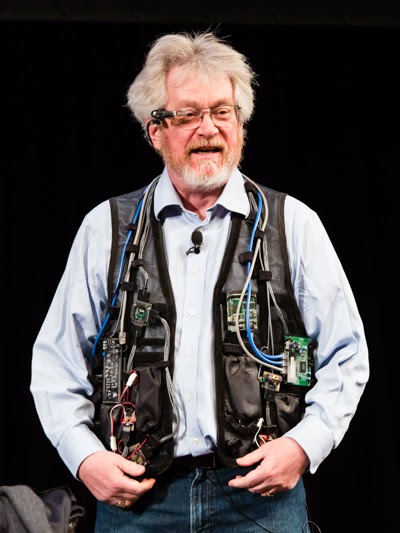
The MIT Media Lab’s Sandy Pentland—decked out in vintage wearables—offered some other potential limits when he noted that the “rate of innovation in technology is much greater than the rate of change in government is much greater than the rate of change in culture. The NSA was a pretty well-governed organization—for the technology of the 1960s.” But, now, he went on to say “Everything is becoming data-fied.” And, while there’s always been a lot of slop in laws and how they’re enforced, that becomes more difficult when there’s potential telemetry and data everywhere. Automatic traffic tickets anyone?
As for passwords? They’re “useless” says Patrick Gilmore of the Markley Group. “If you’re not already using 2-factor authentication, you’re behind.” Nor was he a fan of password managers. Mind you, this is a somewhat enterprise-centric view of security. Tim Bray has argued for federated identity in a broader context. Which requires trusting someone and people generally aren’t very trusting these days. But it’s probably better than the password status quo in a lot of situations. Risk management and security—and their intersection with ever-increasing quantities of data—were also big topics throughout the day. Forrester Research’s Peter Burris, moderating a Leading the Digital Enterprise panel, opined that instead of saying we can protect everything we have, we have to think about what we can do about it afterwards—in addition to continue trying to stop attacks. Equinix’s Brian Lillie agreed, saying “You’re not going to stop everything; it’s a cornerstone of risk management.” And Raytheon’s Rebecca Rhoads spoke about the need to have sophisticated compartmentalization of information, driven by regulations and other factors.
Gilmore also suggested that people coming to his company—Markley’s a colocation provider—“mostly aren’t asking the right questions.” When dealing with cloud and other infrastructure providers, he argued that you should be looking in more depth than most people do. How long do you keep backups? How many versions? What type of physical security do you have? Do you degauss your hard drives when you retire them?
Mark Morrison of State Street also noted that you can’t outsource all of your security and have to think about how all of your security fits together—including all your point security products, your operational processes, and your external providers—and constantly evaluate. He also noted that there’s a “conundrum between privacy and information security—the level of monitoring and sophistication that lets you institute countermeasures."
Security and privacy aren’t the only things that play into data though. There’s also the pesky matter of physics. Lillie discussed hybrid cloud models in this context because “if you have enormous data sets, data gravity is happening. You need to find ways to connect clouds to private enterprises."
If I had to sum up my main takeaways from the day, they’d be something like the following. There’s the potential for many big changes related to computing power, to data, to computing ubiquity. We’re already starting to see some of the results. But some technological distances that seem small aren’t. (Think reliable speech recognition.) And, even more importantly, culture, laws, ethics, and economics all matter. Which is one reasons that CIOs increasingly have to work closely with business owners to deliver on technology promises rather than focusing on the technology alone.
Wednesday, May 14, 2014
Links for 05-14-2014
- The Subway Map That Rattled New Yorkers - NYTimes.com
- Introducing DevOps to Traditional Enterprises
- DevOps Is Great for Startups, but for Enterprises It Won’t Work—Yet - The CIO Report - WSJ
- The Role of CMPs: Why You Should Care - "You can certainly do multi-cloud without using a CMP. However, as your environment gets more complex, a CMP will be in your future at some point. You might as well get started now."
- Film: Plimpton! Starring George Plimpton as Himself | American Masters | PBS - RT @davechensky: My very talented colleague @adamroffman produced a documentary, PLIMPTON!, that's airing on Friday night. Check it:
- Twitter / TechJournalist: Everything you need to do to ... - “@TechJournalist: Everything you need to do to secure an #openstack cloud in one easy slide ” -Or just cut network:-)
- The Mystery of Go, the Ancient Game That Computers Still Can’t Win | Enterprise | WIRED
- The Internet map
- The illusion of life on Vimeo
- Lower East Side Food Tour - Editor and Author Ruth Reichl - Elle - "During our first stop at Katz’s Delicatessen, the New York institution made famous by that scene in When Harry Met Sally, Reichl revealed that when she patronizes the bustling restaurant, she only ever orders the pastrami sandwich. She also tips the carver a few extra dollars and asks that he “make it fatty.” Declared a thoroughly aghast Reichl: “Why would anyone want lean pastrami?” Why, indeed."
- Why Apple’s PR strategy frustrated tech media for almost a decade — Tech News and Analysis
Friday, May 09, 2014
Links for 05-08-2014
- Homepage - All of Bach
- Radio is the New Netflix. Here’s Your Binge Listening Guide. | Xconomy - I already like enough that's on this list to be interested in trying some of the others.
- Infrastructure start-up guy, DSSD exit - congratulations to an awesome team w some context
- Free worldwide Garmin maps from OpenStreetMap
- Like magic, Teller speaks | Harvard Gazette - “@Harvard: Magician @MrTeller and director Aaron Posner bring Shakespeare’s "The Tempest" to @AmericanRep ” See nxt wk
- Dell to HP: You’re Doing OpenStack Wrong! | Re/code
- The 100 Most Important Cat Pictures Of All Time
- Connections: Folksonomies? - Apropos the Delicious acquisition news, here's a piece I wrote on "folksonomies" in 2005.
- YouTube Founders to Sell Delicious, a Social Bookmarking Site - NYTimes.com
- Andrew Sullivan on native ads: Journalism has surrendered | Digiday - "Advertising snuck into the editorial pages in a way that advertising has always wanted to do. It used to be an axiom that the job of journalists was to be resistant to that and sustain the clear distinction between advertising and journalism. One side has effectively surrendered."
- Untitled (http://coteindustries.com/post/84832061261/devops-unicorn-devopsdays-austin-2014) - RT @cote: The recording of my #DevOpsDays Austin keynote is up - - thanks to @BMC_DevOps for recording the whole event!
Wednesday, May 07, 2014
Links for 05-07-2014
- Let’s Make a Bubble Map
- Why Nobody Writes About Popular TV Shows
- CNN, Flight 370, Space Aliens, and Why Your Opinion Does Not Always Matter | TIME.com - "There is one way, I guess, in which this polling might be relevant: if CNN is asking itself whether its heated, speculation-filled marathon coverage, which itself raised the possibility of black holes or supernatural mischief, had so poorly informed the public that a not-insignificant portion of them came to believe the theory. In which case, well, at least someone is asking the right questions."
- The interface from Dev to Ops isn’t going away; it’s rotating – Donnie Berkholz's Story of Data
- The Robot Car of Tomorrow May Just Be Programmed to Hit You | Autopia | WIRED - "While human drivers can only react instinctively in a sudden emergency, a robot car is driven by software, constantly scanning its environment with unblinking sensors and able to perform many calculations before we’re even aware of danger. They can make split-second choices to optimize crashes–that is, to minimize harm. But software needs to be programmed, and it is unclear how to do that for the hard cases."
- Anova Sous Vide Immersion Circulators - Anova seems to have an even lower-priced immersion circulator coming out. I like mine.
Tuesday, May 06, 2014
Links for 05-06-2014
- DevOpsDays Austin: Helping Horses Become Unicorns, Chef's Operation... - Great DevOps preso.
- Enterprise DevOps: Bigger than Dev and Ops (The Invisible Thread)
- Monitorama - Please, no more Minutes, Milliseconds, Monoliths or Mo...
- Star Wars: Machete Order - The Star Wars Machete order meme making the rounds is great Makes sense to me.
- Steven Citron Pousty (Red Hat Openshift) interviewed at Fluent 2014 - YouTube - RT @krishnan: OpenShift’s Steve Citron Pousty (@TheSteve0) on using GIS and MongoDB for interesting mapping apps
- Day 3: Flask--Instant Python Web Development with Python and OpenShift | Openshift Blog
Smart crowds, Irrational individuals?
This is from a presentation/discussion from Boston ProductCamp in May 2014. Here's the abstract: We've all made rational decisions and forecasts based on individually analyzing the best available data. But there are many other aspects of decision making. This session will examine some of those. When can groups of non-expert individuals beat some of the best experts? What are some of the common biases that cause ordinary people to make decisions differently from those that they "should" make. Can you take advantage of the ways other makes decisions or is this unwarranted manipulation?
Monday, May 05, 2014
Automation and autonomy
I’ve been thinking and reading about autonomous systems of late—both autonomous IT systems and autonomous systems of other types such as vehicles. I also read a lot of misconceptions about automation—whether it’s in the arguments against or in misunderstanding what automation really means. I’ll be writing further on the topic but here are five points to get started. Comments welcome.
Computers are good at things that can be automated
Back in my earlier life at Data General, we were selling some of the earlier symmetrical multiprocessor (SMP) servers to large enterprises, including Wall Street. SMP introduced a new wrinkle. Where to place individual processes so that the system as a whole, with its multiple processors, ran most efficiently. One approach was to manually place them—which is precisely what a number of our big customers wanted to do; we even wrote and sold them class software to help them do so. But know what? The operating system scheduler could actually do this job pretty well in the aggregate, as all these customers eventually recognized.
There are legitimate questions about what tasks can be readily handled by computers and which can’t. With respect to self-driving cars specifically, computer AI interacts with the physical world much differently from a human. It’s fair to say that computers will be able to do many things much better than can even a good driver while handling other situations will prove very difficult to solve. With datacenter computing though, it’s clear than many tasks have to be eventually automated and exceptions should be relatively rare.
Assistance can precede automation
Yet, even when complete automation isn’t (yet) achievable, it can still be used to significantly offload how many activitie people need to do. We’re already seeing this in automobiles with technologies like adaptive cruise control, which can adjust a car’s speed to maintain a safe distance from any vehicles ahead. Such systems are mostly in luxury cars today but I expect they’ll become both more widespread and more sophisticated. And judiciously applied assistive systems can be rolled out far more incrementally than anything taking over full control.
The same is true with cloud computing. One example that I like to use is around the idea of cloudbursting—typically used to mean the dynamic movement of workloads from private to public clouds in response to an increase in demand. As I’ve written previously, this strong form of cloudbursting—much less the idea of workload movement in response to changes in public cloud spot pricing—gets into a lot of complications. However, hybrid cloud management software and operating systems that can run in different environments make it possible to move applications around as needed (e.g. to switch cloud vendors) even if the process isn’t necessarily completely autonomous and hands-off.
Automation isn’t all or nothing
Even when hands-off automation works well and is appropriate for some tasks, it may not be used—or may be used under a more rigorous set of controls—elsewhere. With respect to self-driving cars, I can easily imagine an interim stage where they can drive autonomously on designated sections of limited access highways—and not elsewhere. For anyone who commutes on the highway or does long Interstate drives, this should be an obvious win even if its not the nirvana of a robo-Uber.
Similarly, while “automate more” should be IT’s mantra, most companies aren’t starting from scratch. It won’t always make as much sense to aggressively automate stable legacy systems as it will to automate through a new OpenStack infrastructure that’s running primarily new cloud-enabled workloads. Standardizing and automating are effective at cutting costs and reducing errors just about everywhere—but the bang for the buck will be bigger in some places than others.
But autonomy requires a defined control handoff
The above said, the handoff between manual (even if assisted) and autonomous needs to be clearly defined. Once you hand off control, you had better trust the autonomous system to do the right thing (within whatever margin of error you deem acceptable). You can’t wrest back control on the fly; it’s probably too late.
In so many autonomous car discussions, I hear statements to the effect of: “If there’s an emergency, the driver can just take over.” Well, actually he can’t. He’s playing a game on his iPad and he probably needs a good 30 seconds to evaluate the situation and take any corrective action. OK for some situations, not for others. If the car’s in control, it has to deal with things itself—at least anything urgent.
With complex distributed IT systems, as increasingly characterize cloud environments, it’s certainly important to understand what’s going on. But events happen and cascade at incredibly short time scales by human standards. Check out this presentation by Adrian Cockroft of Battery Ventures in which he talks about some of the challenges associated with monitoring of large-scale architectures.
Autonomy can require new approaches/workflows
Finally, the best way to automate is likely not to just automate the old thing, certainly not if the old thing is a mess. A clean sheet approach may be constrained by coexisting with what’s already in place to be sure. The infrastructure that we’d build for 100% self-driving cars is much different than what we would build (and have built) for a 100% human one. However, even given a mixed environment, I suspect that over time we’ll add some infrastructure to help autonomous cars do things that they’d have trouble doing otherwise.
In the case of IT, we’re seeing new classes of tools oriented to large-scale cloud workloads and DevOps processes. One big thing about these tools from those of the past is that they’re mostly open source. Donnie Berkholz of RedMonk discusses some of them in OpenDevOps: Transparency and open source in the modern era. These include configuration management like Puppet and Chef as well as monitoring and analysis tools like Nagios and Splunk. DevOps itself, whatever your precise definition, is very much tied into the idea that much of the manual, routine ops work of the traditional system admin is increasingly automated. This is the only thing enabling a developer to take over so many ops tasks.
Automation done right is a huge positive. But we need to understand what it is, how to use it, and how to interact with it.
[Photo credit: BMW. BMW Spartansburg SC assembly plant.]
Links for 05-05-2014
- Google’s Road Map to Global Domination - NYTimes.com
- Absolutely No Machete Juggling » The Star Wars Saga: Introducing Machete Order
- Always Print Your Travel Itinerary (All-Electronic Isn't) - View from the Wing - View from the Wing - I think this is good advice--especially for international travel:
- How hardware shapes software - CNET
- Madrid's smart parking meters to charge more for most polluting cars | World news | The Guardian - RT @jkirklan: #iot brings complex variable pricing to the world. Usage or class based prices will allocate costs precisely e.g.,
- GearD: The Intersection of PaaS, Docker and Project Atomic | Openshift Blog
- Inktank Acquisition - RT @Obdurodon: My thoughts about Red Hat acquiring Inktank. tl;dr This rocks.
- Glacier redux - Interesting that Amazon has been able to keep this a secret. Supposedly informed (but unnamed) sources last year claimed it was tape. I still put it all in the speculation bucket.
- Computer History Museum | Exhibits | This Day in History: April 25 - RT @sandhillstrat: 53 yrs ago today, patent for integrated circuit issued to Robert Noyce. World has never been same #history
- GOVERNOR PATRICK ANNOUNCES FUNDING TO LAUNCH MASSACHUSETTS OPEN CLOUD PROJECT, CELEBRATES RELEASE OF 2014 MASS BIG DATA REPORT » MassBigData - Massachusetts Open Cloud was announced last Friday. Creating new public cloud infrastructure for big data
- Advice to young critics | MZS | Roger Ebert - A lot of this applies well out of film etc. criticism as well.
- Apple's iPhone 5c ate up Android while Google's Moto X flopped: why everyone was wrong
- New Old Stock
- The New Stack - RT @heathercfitz: Congratulations to @alexwilliams and @thenewstack editorial team for the launch of a new, very cool site
- New York City Subway Maps Across Time
- DevOps: Caution Ahead | DevOps.comDevOps.com - “I started working with those sort of DevOps-y concepts back before I was aware of the term “DevOps,” Mortman adds. “I was calling it “Agile InfoSec” and “Agile Ops.” And with that mindset, even the most regulated, paranoid enterprise can embrace DevOps. Start with small, modestly achievable goals and build from there. Collaborate and more tightly integrate the teams.
- The Invention of Jaywalking Was a Massive Shaming Campaign
Thursday, May 01, 2014
Podcast: Autonomous vehicles, passwords, and IoT with Gordon and Ellen
In the first episode of a new Cloudy Chat feature, I sit down for a free-wheeling discussion with one of my Red Hat colleagues. Today, my co-host is Ellen Newlands who is the product manager for identity management at Red Hat. We start with self-driving cars and other autonomous vehicles and move onto the Internet-of-Things against a background of security and privacy implications in all of this.
A few links to go with the podcast:
Google self-driving cars
FreeOTP
Federated Identity, Tim Bray
McKinsey article on the Internet of Things
Listen to MP3 (0:31:38)
Listen to OGG (0:31:38)
Monday, April 28, 2014
Links for 04-28-2014
- Hadoop is Beginning to Stare Newer Big Data Approaches in the Face | Big Data Blogs | DATAVERSITY
- How To Survive NYC - Business Insider - “@j0el: Beware the empty train car -- How To Survive NYC - Business Insider ” << Great and so true.
- Nike Fuelband’s Fall From Grace - The Daily Beast - RT @thedailybeast: Nike's Fuelband assumed that Americans want to live like athletes. They really just prefer the occasional walk
Thursday, April 24, 2014
Links for 04-24-2014
- geard/docs/orchestrating_geard.md at master · openshift/geard · GitHub
- The Court's Net-Neutrality Ruling Isn't Actually That Bad - Kevin Werbach - The Atlantic - MT @kwerb: ... after the DC Circuit court case on #netneutrality, and which I still believe: << good commentary
- No Exit | Business | WIRED
- Getting Started with OpenShift | OpenShift by Red Hat - Get a free ebook of O'Reilly's Getting Started with OpenShift
- Twitter / censquare: H Mart mobbed in Central ... - “@censquare: H Mart mobbed in Central ” << Great to see H-Mart there. Can never get to Burlington.
- Opensource.com's 2014 Community Awards | opensource.com - RT @TheGirlsGuild: Congrats Lauren Egts, member of the Fighting Unicorns and Winner of the 2014 Community Awards
- Kinvey bulks up its support for HTML5 development — Tech News and Analysis - A lot of the forces driving clients to mobile apps rather than HTML5 don't apply so much in enterprise space
- BUx: SABR101x: Sabermetrics 101: Introduction to Baseball Analytics | edX - .@sogrady may be interested in this edX course on Sabermetrics if he isn't already aware of. (I signed up.)
- Twitter / cote: Red Hat jumps on all the right ... - RT @cote: Red Hat jumps on all the right cloud bandwagons, focusing on new appdev, my #rhsummit report